

In 1811, to mark the birth of their son, Napoleon gave his second wife, the Empress Marie-Louise, a necklace of 234 diamonds. A jeweler who examined it that year valued it at 376,275 French francs, roughly what her household cost to run for a year (GIA, Gems & Gemology). Within three years the empire had fallen and she had carried it home to Vienna. Over the next century and a half it was shortened by an archduchess, inherited by a widow, nearly sold out from under her by a pair of impostors in New York, and finally given to the American people by a cereal heiress, still in its original case (the Smithsonian). This is the story of the Napoleon Diamond Necklace told through its owners, and what it teaches anyone who keeps a family jewel. For more jewelry stories, start with The Jewelry Worth Knowing.
The Collector’s Summary
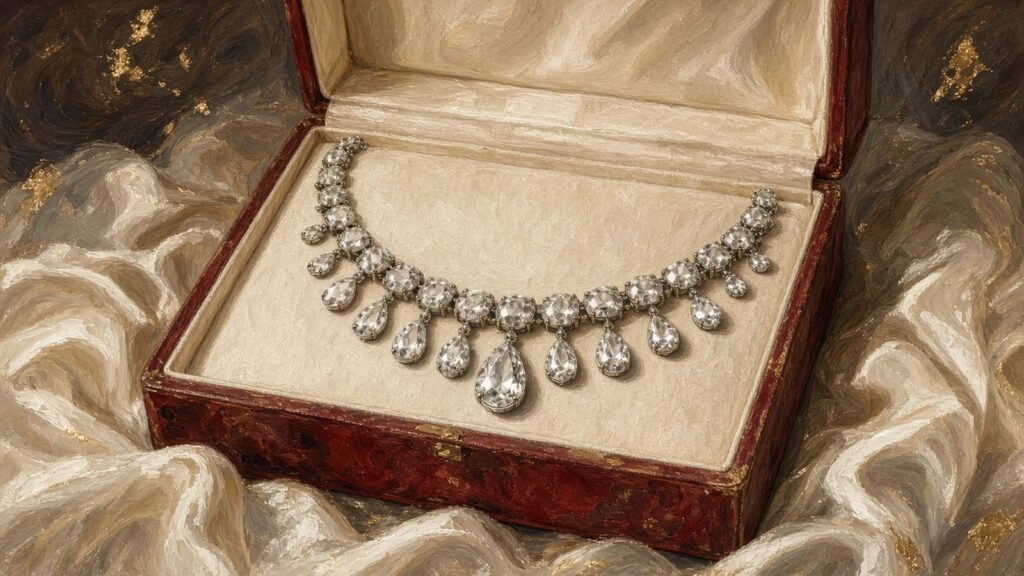
The Napoleon Diamond Necklace is a silver-and-gold necklace of 234 old-cut diamonds, about 263 carats in all, made by Etienne Nitot et Fils of Paris in 1811. Napoleon gave it to Empress Marie-Louise to celebrate the birth of their son, Napoleon II. It stayed with her Habsburg family until 1948, and Marjorie Merriweather Post gave it to the Smithsonian’s National Museum of Natural History in 1962, where it is on display today (the Smithsonian).
Read the timeline of owners and what it teaches a jewelry owner.
Why did Napoleon give Marie-Louise a diamond necklace?
It was a gift for the birth of their son. Napoleon married Archduchess Marie-Louise of Austria, his second wife, on 2 April 1810 (the Louvre). In 1811 she gave birth to Napoleon François Joseph Charles, styled the King of Rome, and the necklace celebrated his arrival (GIA, Gems & Gemology, the Smithsonian).
It was not her first Nitot commission. For the wedding, Napoleon had ordered two personal parures from the same house, one of emeralds and diamonds and one of opals and diamonds, delivered at the end of March 1810 (the Louvre). The difference mattered later: these pieces were hers, not part of the French Crown Jewels, so she could take them with her when the empire fell. Several portraits show her wearing the diamond necklace, including one by Giovan Battista Borghesi painted while she was Duchess of Parma, now in the Galleria Nazionale in Parma (GIA, Gems & Gemology).
What is the Napoleon Diamond Necklace made of?
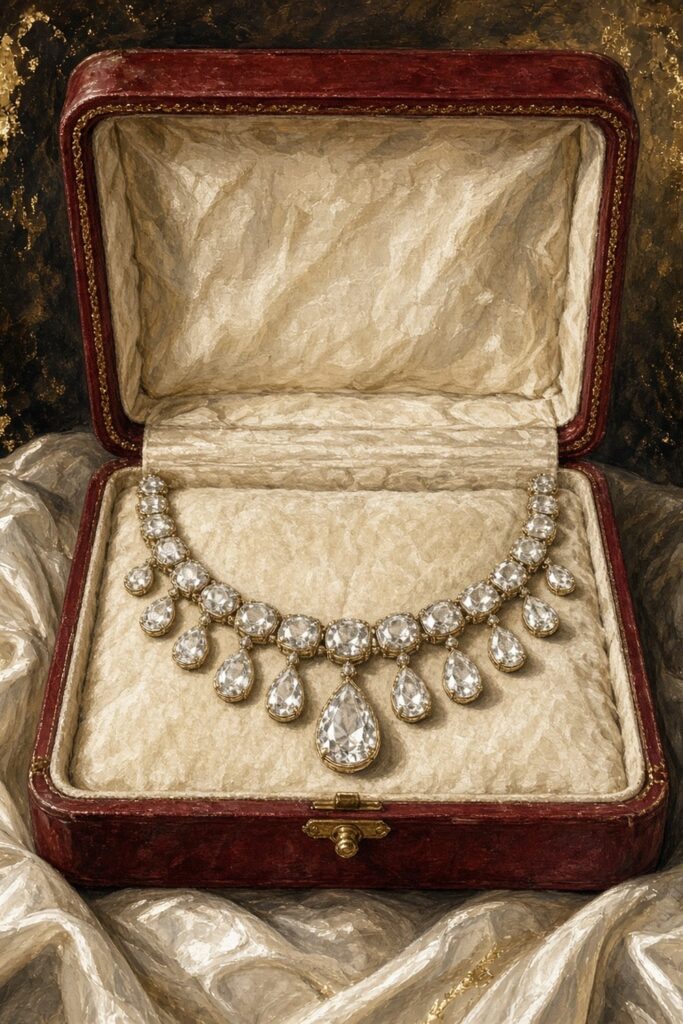
It is 234 diamonds set in silver and gold, about 263 carats in total. Twenty-eight old mine-cut diamonds form the collar. From it hang nine pendeloques, five pear shapes alternating with four ovals, and 10 briolettes, each briolette mounting set with 12 rose-cut diamonds. The largest stone weighs about 10.4 carats (the Smithsonian, GIA, Gems & Gemology).
Old mine cuts are the ancestors of the modern round brilliant. As the Smithsonian explains, they throw strong flashes of color but less white brilliance than a modern cut. In 2007 Smithsonian researchers Eloïse Gaillou and Jeffrey Post tested the stones for Gems & Gemology. They found that 13 of the 52 larger diamonds are type IIa, a rare, nearly nitrogen-free kind, including seven of the nine large pendeloques (GIA, Gems & Gemology). Their conclusion: the standards used to choose the finest diamonds 200 years ago were close to the ones used today.
Who owned the necklace after Napoleon fell?
Marie-Louise kept it for the rest of her life. When she left Paris on 29 March 1814 she handed back the Crown Jewels but kept her personal jewels (the Louvre), and she returned to her Habsburg family in Vienna with the necklace (the Smithsonian). She died in 1847.
The necklace then passed to her sister-in-law, Archduchess Sophie of Austria, who made the only lasting change to it: she had two stones removed to shorten it and set them into a pair of earrings, whose whereabouts are unknown (the Smithsonian). After Sophie’s death in 1872 it went to her sons. One of them, Archduke Karl Ludwig, bought out his two brothers’ shares, and when he died in 1914 it passed to his third wife, Archduchess Maria Theresa (GIA, Gems & Gemology).
What happened when the necklace was sold in New York in 1929?
It was nearly lost to a pair of impostors. In 1929 Maria Theresa sent the necklace to the United States to be sold. Her agents presented themselves as “Colonel Townsend,” supposedly of the British Secret Service, and his wife “Princess Baronti,” a novelist. Neither description was true, and their real identities have never been confirmed (GIA, Gems & Gemology).
She wanted $450,000. After the stock market crash that October, the Townsends enlisted Archduke Leopold, her grandnephew, to vouch for the necklace and to tell buyers it was a $100,000 bargain because the archduchess needed the money. Harry Winston and a Boston buyer both backed out. A New York diamond dealer, David Michel, bought it for $60,000. The Townsends sent Maria Theresa $7,270 and kept $52,730 as “expenses,” reportedly including $20,000 for Leopold (GIA, Gems & Gemology).
She had already revoked their authority and sent an emissary to New York to recover it. The case went to court; the necklace was returned to her, Leopold went to jail and the Townsends disappeared (GIA, Gems & Gemology).
How did the Napoleon necklace reach the Smithsonian?
Through Harry Winston and Marjorie Merriweather Post. The Habsburg family sold the necklace in 1948, according to the Smithsonian through Prince Franz Joseph of Liechtenstein, Karl Ludwig’s grandson, to a French collector; the Gems & Gemology account names him as the Paris industrialist Paul-Louis Weiller (GIA, Gems & Gemology). Harry Winston acquired it in 1960, thirty-one years after he had walked away from the Townsends’ offer, and sold it to Post.
Post, the cereal heiress (WTOP News), gave it to the Smithsonian in 1962 in its original case (the Smithsonian). Her researcher, Marvin C. Ross, had worked in the French National Archives on its history, and his notes are kept at Hillwood Estate, Museum & Gardens, her former Washington home, with copies at the Smithsonian (GIA, Gems & Gemology). It is displayed in the National Museum of Natural History’s gem gallery beside the Marie-Louise Diadem, another Napoleon gift that Post later gave the museum (the Smithsonian). The Hope Diamond, which Winston gave the same museum in 1958, is a short walk away.
Was the Napoleon Diamond Necklace stolen from the Louvre?
No. The Napoleon Diamond Necklace is in Washington. The necklace stolen from the Louvre on 19 October 2025 was a different jewel: the emerald-and-diamond necklace from Marie-Louise’s 1810 wedding parure, taken with its matching earrings and six other pieces from the Galerie d’Apollon (French Ministry of Culture, BBC News).
That parure had its own path. Marie-Louise left it to her aunt, it stayed with Habsburg descendants until 1953, and it was sold to Van Cleef & Arpels, which sold the diadem’s emeralds one by one. The necklace and earrings survived intact and the Louvre acquired them in 2004 (the Louvre). The diadem, reset with Persian turquoise in the 1950s, is the one now at the Smithsonian (Smithsonian Magazine). The Louvre estimated the stolen jewels at 88 million euros (the Louvre), and one year after the theft they were still missing (France 24).
The Napoleon Diamond Necklace: a timeline of owners
| Year | Owner or event | Source |
|---|---|---|
| 1810 | Napoleon marries Marie-Louise; Nitot delivers her personal emerald and opal parures | the Louvre |
| 1811 | The diamond necklace is made by Nitot for the birth of the King of Rome; valued at 376,275 francs | GIA, Gems & Gemology |
| 1814 | Marie-Louise leaves Paris and takes her personal jewels to Vienna | the Smithsonian |
| 1847 | Marie-Louise dies; the necklace passes to Archduchess Sophie, who removes two stones | the Smithsonian |
| 1872 | Inherited by Sophie’s sons; Archduke Karl Ludwig buys out his brothers | GIA, Gems & Gemology |
| 1914 | Passes to his widow, Archduchess Maria Theresa | GIA, Gems & Gemology |
| 1929 | Impostor agents sell it in New York for $60,000; a court returns it to her | GIA, Gems & Gemology |
| 1948 | Sold by the Habsburg family to a French collector (Paul-Louis Weiller) | GIA, Gems & Gemology |
| 1960 | Acquired by Harry Winston, Inc., then sold to Marjorie Merriweather Post | the Smithsonian |
| 1962 | Given by Post to the Smithsonian in its original case | the Smithsonian |
| 2007 | Smithsonian researchers publish its gemological study: 13 of 52 larger stones are type IIa | GIA, Gems & Gemology |
What the Napoleon necklace teaches anyone who owns a family jewel
Very few of us will inherit an empress’s diamonds. Many of us will inherit a ring, a strand or a brooch with a story, and the reasons this necklace survived with its name intact apply to those pieces too.
- Keep the case and the paper. Post gave the necklace with its original case, and its history is “well documented” because someone did the archive work (GIA, Gems & Gemology). Keep fitted boxes, receipts, letters and old photographs of a piece being worn together, and write down what you know while the people who remember are still here. Our authenticity checklist lists what to keep.
- Record every alteration. Two stones left the necklace in the nineteenth century, and the earrings made from them are lost (the Smithsonian). If a piece is shortened, resized or reset, keep the removed stones with a note of what was done, by whom and when.
- Put a sale in writing, with someone you have checked. Maria Theresa’s agents were not who they said they were (GIA, Gems & Gemology). If you consign a valuable piece, use an established auction house or dealer, check their identity and references yourself, and get a signed agreement that sets the minimum price, the term and how you can end it.
- Know what your diamonds are. The necklace’s stones were only fully characterized in 2007 (GIA, Gems & Gemology). For an old-cut stone, a report from a laboratory such as the GIA lab records what it is before anyone suggests recutting it into a modern shape. Our guide to reading a GIA grading report explains what a report records.
- Check which piece a famous name belongs to. Napoleon gave Marie-Louise more than one necklace, and the emerald one stolen in 2025 is not the diamond one in Washington (the Louvre). When a listing or a family story attaches a famous name, match the description, maker and documents to that exact piece.
- Decide where it goes next. Marie-Louise named her heirs and Post chose a museum. A will or a letter of wishes that names the piece and the person avoids the kind of division Karl Ludwig had to buy his way out of (GIA, Gems & Gemology).
Care matters too. Two-hundred-year-old silver-topped settings show their age; the Smithsonian study found repaired solder joints and a few chipped stones (GIA, Gems & Gemology). Our guide to caring for fine jewelry covers storage and when to have prongs checked, and reading gold hallmarks explains the marks you will find on older pieces.
Questions people ask
Where is the Napoleon Diamond Necklace now?
It is at the Smithsonian’s National Museum of Natural History in Washington, D.C., in the gem gallery beside the Marie-Louise Diadem. Marjorie Merriweather Post gave it to the museum in 1962, in its original case, after buying it from Harry Winston.
Was the Napoleon Diamond Necklace stolen?
No. The piece stolen from the Louvre on 19 October 2025 was the emerald-and-diamond necklace from Marie-Louise’s 1810 wedding parure, with its matching earrings. The Napoleon Diamond Necklace, a separate 1811 gift, is on display at the Smithsonian.
How much is the Napoleon Diamond Necklace worth?
There is no current price. It has not been sold since about 1960 and the Smithsonian publishes no valuation. When new in 1811 it was valued at 376,275 francs, and in 1929 its owner asked $450,000 before impostor agents sold it for $60,000.
How many diamonds are in the Napoleon Diamond Necklace?
It has 234 diamonds weighing about 263 carats in total, set in silver and gold. The largest stone weighs about 10.4 carats. Thirteen of the 52 larger diamonds are the rare, nearly nitrogen-free type IIa, according to a 2007 Smithsonian study.
Why did Napoleon give Marie-Louise the diamond necklace?
He gave it to celebrate the birth of their son, Napoleon II, the King of Rome, in 1811. It was made by Etienne Nitot et Fils of Paris, the firm that had also made her emerald and opal wedding parures in 1810.
Another imperial jewel that left its first home in a hurry: the Grand Duchess Vladimir Tiara, carried out of revolutionary Petrograd in a Gladstone bag in 1917 and sold to Queen Mary four years later.
Another French imperial jewel with a long road home: Empress Eugénie’s bow brooch, sold by France in 1887, bought back by the Louvre in 2008 and stolen in 2025.
For a Breguet watch ordered by Napoleon’s sister, read The Queen of Naples’ Breguet
For another diamond of the French crown, read The Regent Diamond
Sources
- Smithsonian National Museum of Natural History, “Napoleon Diamond Necklace” (NMNH G5019)
- Eloïse Gaillou and Jeffrey E. Post, “An Examination of the Napoleon Diamond Necklace,” Gems & Gemology 43, no. 4 (Winter 2007), pp. 352–357
- Smithsonian National Museum of Natural History, “Marie Louise Diadem”
- Smithsonian Magazine, “How Turquoise Replaced Emeralds in This Royal Diadem” (16 December 2021)
- Musée du Louvre, “Collier en émeraudes de la parure de Marie-Louise” (OA 12155), collections database
- French Ministry of Culture, statement on the 19 October 2025 theft at the Louvre
- Musée du Louvre, Trajectoires 2025 annual report, “Le vol du 19 octobre 2025”
- BBC News, “‘Priceless’ jewels stolen in raid on Louvre Museum in Paris” (19 October 2025)
- France 24 / AFP, “Louvre’s $100 million crown jewels still missing one year after daring heist” (19 October 2026)
- WTOP News, “Trinkets and tiaras: Where to see royal jewels in DC” (May 2023)
- Hillwood Estate, Museum & Gardens
Finely Owned is independent and isn’t affiliated with the Smithsonian Institution, the Louvre, Hillwood, GIA, Harry Winston or Chaumet.