

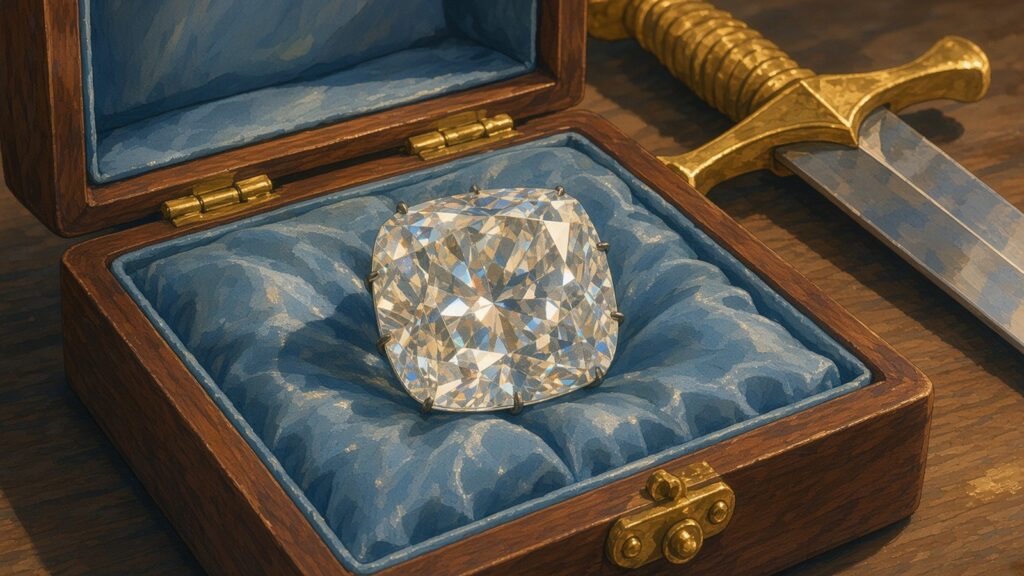
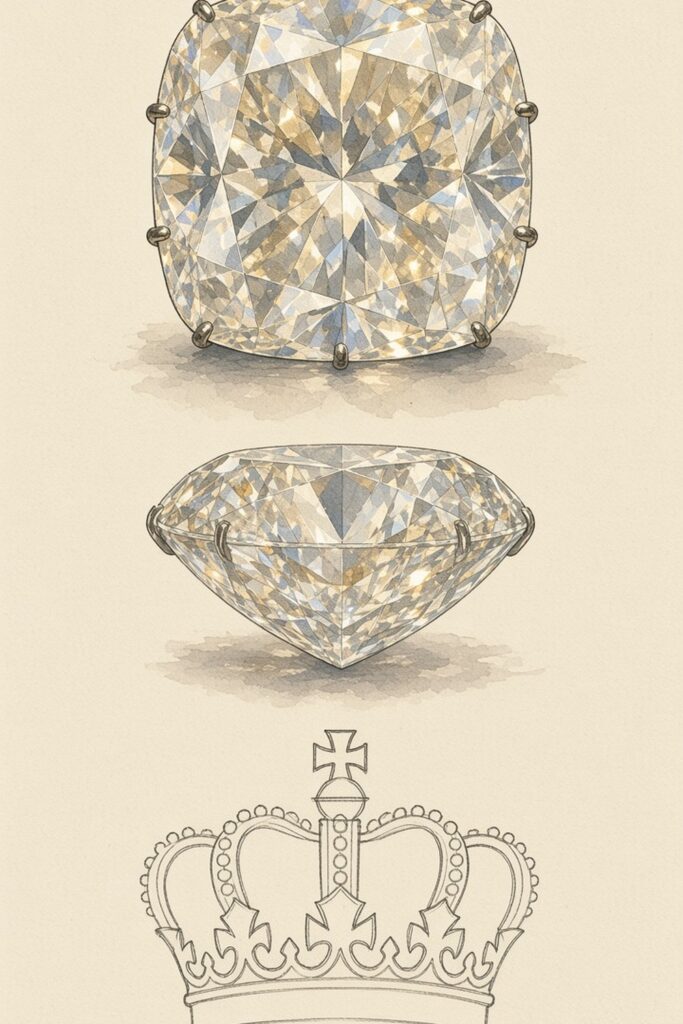
The Regent is a cushion-shaped diamond of about 140 carats, found in the Golconda mines of India in 1698, cut in England and bought for the French crown in 1717 (Louvre). The Louvre calls it, still today, the most beautiful diamond in the world for its purity and the quality of its cut (Louvre). It has been worn by kings, set in Napoleon’s sword, stolen once, and in October 2025 left behind by the thieves who raided the Louvre’s Apollo Gallery (The Guardian). Here is what the record shows, and what it teaches collectors.
The Collector’s Summary
Thomas Pitt, the English governor of Fort St George in Madras, bought the rough stone, which weighed 426 carats before it reached England in 1702 (Louvre). A London cutter named Harris shaped it between 1704 and 1706, and the Regent of France, Philippe d’Orléans, had the Regency Council buy it on 6 June 1717 (Louvre). It has belonged to the French state ever since, and was assigned to the Louvre in 1887 (Louvre).
Jump to the timeline or what it teaches collectors.
Why is it called the Regent?
Because of the man who bought it. Philippe d’Orléans ruled as regent from 1715 to 1723, while Louis XV was a child, and used the prosperity of John Law’s financial system to persuade the Regency Council to make the purchase (Louvre). Before that it was known after its English owner as the Pitt (Louvre). The Louvre says that by 1719 it had already tripled in value (Louvre).
Where did it come from?
From the Golconda mines in India, in 1698 (Louvre). Its route to Pitt is unclear. A well-known legend says a slave smuggled the rough stone out of the mine in a wound in his leg; the Louvre’s curator Anne Dion calls that “certainly implausible,” since no one could hide a stone that size in a leg (Louvre). The Louvre’s collection record says the cutting produced several secondary stones that were sold to Tsar Peter the Great (Louvre). The Louvre’s own sources differ by a year on the cutting dates; the collection record gives 1704 to 1706, which we use.
Who wore it?
Almost every French sovereign after 1717. Louis XV first wore it in 1721, to receive the Ottoman embassy, and had it set in his coronation crown on 25 October 1722; after his marriage he wore it on his hat (Louvre). Louis XVI’s crown of 11 June 1775 carried it at the front (Louvre). Napoleon Bonaparte had it set in the hilt of his sword as First Consul in 1801, made by the goldsmiths Odiot, Boutet and Nitot, and in 1812 in his imperial sword by Nitot (Louvre). Later it was set in the crowns of Louis XVIII, Charles X and Napoleon III, and finally in the Greek diadem of Empress Eugénie (Louvre).
How was it stolen in 1792?
In the great theft of the French crown jewels from the Garde-Meuble, the royal furniture store on what is now the Place de la Concorde. Anne Dion says the thieves climbed the facade to a balcony and came back over four nights in September 1792, and that the Regent was taken on the second night (Louvre). It was found in 1793, hidden in a roof timber (Louvre). The governments of the Directory and the Consulate then pledged it several times to raise money, before Bonaparte recovered it for good in 1801 (Louvre).
What happened in the 2025 Louvre robbery?
The Regent was not taken. On 19 October 2025, thieves broke into the Apollo Gallery in about seven minutes and stole eight pieces, including a necklace and earrings Napoleon gave Empress Marie-Louise and Empress Eugénie’s diadem, brooch and bow (The Guardian). The Guardian reported that they also missed the Regent diamond, which it said Sotheby’s had valued at more than $60 million (The Guardian). We found no independent record of that valuation beyond the press report, so treat it as reported.
The timeline
| Date | What happened | Source |
|---|---|---|
| 1698 | The rough stone is found in the Golconda mines, India | Louvre |
| 1702 | Thomas Pitt’s stone, 426 carats, reaches England | Louvre |
| 1704–1706 | Cut in London by Harris into a cushion brilliant | Louvre |
| 6 June 1717 | Bought for the French crown under the Regent, Philippe d’Orléans | Louvre |
| 25 October 1722 | Set in Louis XV’s coronation crown | Louvre |
| 11 June 1775 | Set at the front of Louis XVI’s coronation crown | Louvre |
| September 1792 | Stolen from the Garde-Meuble | Louvre |
| 1793 | Found hidden in a roof timber | Louvre |
| 1801 | Recovered by Bonaparte and set in his First Consul’s sword | Louvre |
| 1887 | Assigned to the Musée du Louvre | Louvre |
| 19 October 2025 | Left behind in the Apollo Gallery robbery | The Guardian |
What it teaches collectors
Provenance is a paper trail, not a legend. The Regent’s value rests on royal inventories and museum records, while the most famous story about its origin is one the Louvre itself rejects. When a seller tells you a romantic story about a stone, ask for the paperwork behind it, and for a modern diamond, a laboratory report. The trade body Collectif Diamant lists the Regent at 140.64 carats (Collectif Diamant), a reminder that exact weights come from measurement, not memory. Use our authenticity checklist before you pay for a story.
For another jewel from the same French collection, read Empress Eugénie’s bow brooch. For another stone that passed through the French crown, see the Sancy diamond, and for a gift from Napoleon that left France, see the Napoleon Diamond Necklace. For India’s most famous diamond, read the Koh-i-Noor, and for every jewelry story in one place, see the jewelry guide.
Questions people ask
Where is the Regent diamond now?
In the Musée du Louvre in Paris. It was assigned to the museum in 1887 and belongs to the French state.
Was the Regent diamond stolen in the 2025 Louvre robbery?
No. The thieves took eight pieces from the Apollo Gallery on 19 October 2025 but left the Regent behind, according to The Guardian.
How big is the Regent diamond?
About 140 carats, according to the Louvre. The rough stone weighed 426 carats before it was cut in London between 1704 and 1706.
Why is it called the Regent?
It is named for Philippe d’Orléans, regent of France from 1715 to 1723, under whom the crown bought it in 1717. Before that it was called the Pitt.
For another diamond from a European crown, read The Wittelsbach-Graff Diamond
For the pink diamond stolen with it in 1792, read The Hortensia Diamond
Sources
- Musée du Louvre, Diamant, dit “le Régent” (collection record)
- Musée du Louvre, Les Enquêtes du Louvre: Le Régent (podcast transcript)
- The Guardian, How the Louvre museum robbery happened (20 October 2025)
- Collectif Diamant, Le Régent
Finely Owned is independent and isn’t affiliated with the Musée du Louvre or Sotheby’s.