
In February 1981, Lady Diana Spencer was shown a selection of rings by Garrard, then the Crown Jeweller, and chose one that broke with convention: not a diamond solitaire but a large oval blue sapphire inside a ring of fourteen diamonds. Within days the ring was recognised around the world. Twenty-nine years later her elder son carried the same ring in a rucksack through Kenya before giving it to Catherine Middleton. Few jewels have a documented line of ownership this clear, and fewer still have changed what ordinary couples ask for at the jeweler’s counter. This is the story of the ring, told from the sources, and what it can teach anyone who owns or is thinking of buying a sapphire cluster today. For the wider picture, start with our jewelry guide.
The Collector’s Summary
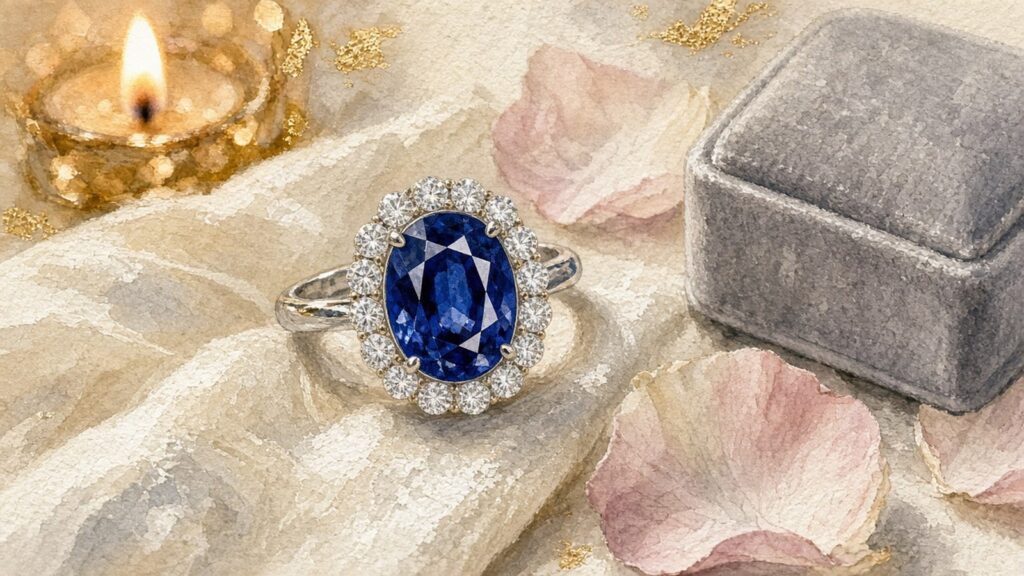
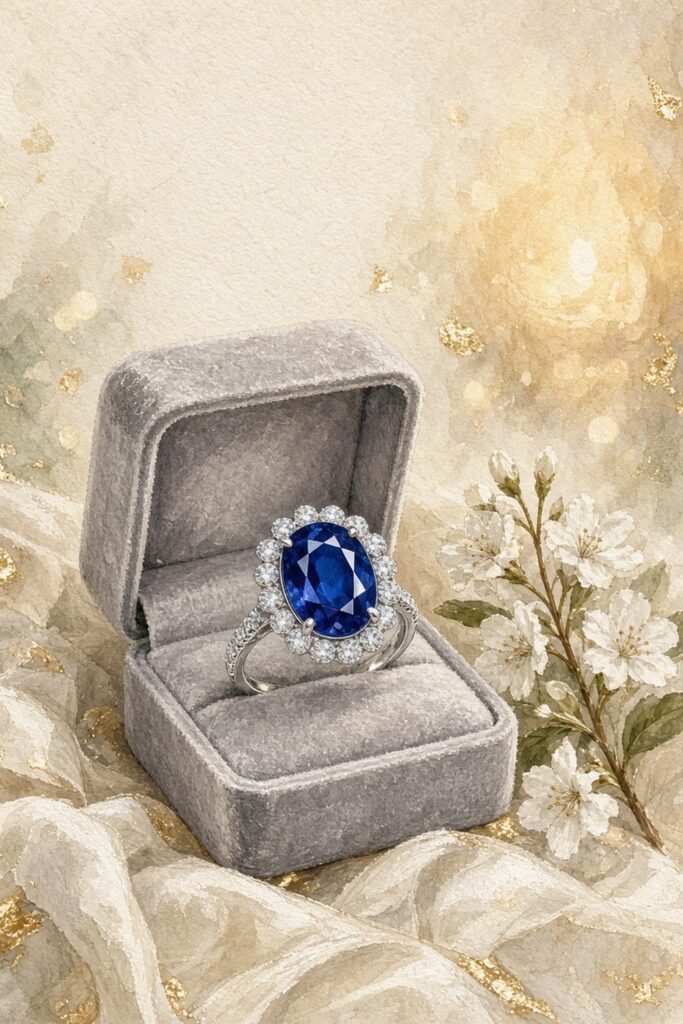
Princess Diana’s engagement ring is a 12-carat oval Ceylon sapphire framed by 14 round diamonds in 18-carat white gold, chosen from Garrard in February 1981. After her death in 1997 it passed to Prince William, who proposed to Catherine Middleton with it in Kenya in October 2010. It is now worn by Catherine, Princess of Wales.
Read the timeline and what the ring teaches a buyer.
Why did Diana choose a sapphire instead of a diamond?
Nobody can say with certainty, and the honest answer is that accounts differ. Annie Sulzberger, lead researcher on “The Crown,” told Vogue UK that the theories range from the colour matching Diana’s eyes, to the Queen having made the choice, to Diana’s own reported remark that “it was the biggest,” to the ring reminding her of her mother’s engagement ring, as reported by Business Insider. What is documented is the choice itself. The Times described the ring as unconventional at the time, because diamonds were traditionally the centrepiece of an engagement ring.
There is also a family echo in the design. Garrard says the ring references a sapphire-and-diamond brooch that Prince Albert gave Queen Victoria on the eve of their wedding in February 1840, as its head of design explained to Town & Country. Victoria wore the brooch at her wedding. Its exact origin is debated: newer research cited by Young Queen Victoria suggests it was bought from a Dutch court jeweller rather than commissioned from Garrard. Either way, a blue centre stone with a white surround already had a royal history long before 1981.
Was Princess Diana’s ring a catalogue ring?
It depends on whom you ask, and the disagreement is part of the ring’s story. The royal jewellery historian Lauren Kiehna of The Court Jeweller has written that the ring was technically available as a stock item, so anyone with the means could have bought one, according to Business Insider. Jewellery experts quoted by The Times in 2010 called the idea that others could have bought the same ring a common misconception, saying that while it was not designed specifically for her, it was unique.
Both positions can be true at once. A jeweler can offer a design to several clients while each finished piece, built around its own centre stone, remains one of a kind. No two natural sapphires of that size share the same colour, inclusions and cut, which is exactly why the stone, not the drawing, carries the identity of the ring. When curators of the 2021 Kensington Palace exhibition Royal Style in the Making wanted to show the ring, they displayed Garrard’s original watercolour design drawing instead, according to Town & Country.
What happened to the ring after 1997?
Diana died in Paris in 1997. The Times reported in 2010 that Prince William is understood to have asked for the ring after his mother’s death, and that he said it symbolised a time in his parents’ lives when they were truly happy.
In October 2010, during a holiday in Kenya, William proposed to Catherine Middleton. In their first interview as an engaged couple he said the ring had travelled in his rucksack for a few weeks before he found the right moment, and that he held on to it tightly because he knew he would be in trouble if he lost it, as the BBC’s live coverage recorded. When the engagement was announced on 16 November 2010, he explained the choice: giving Catherine his mother’s ring was “my way of making sure my mother didn’t miss out on today and the excitement,” as reported by the BBC. He added that no one was trying to fill his mother’s shoes.
The Times reported that the ring was understood to be a perfect fit and needed no adjustment. That small detail matters more than it seems: a ring that does not have to be cut or rebuilt keeps its original construction, which is a large part of why heirloom pieces are valued the way they are.
A timeline of Princess Diana’s engagement ring
Dates and details below come from the sources listed at the end of this story. Where accounts differ, the table says so.
| Year | What happened | Source |
|---|---|---|
| 1840 | Prince Albert gives Queen Victoria a sapphire-and-diamond brooch on the eve of their wedding; Garrard later cites it as the reference for Diana’s ring (its maker is debated) | Town & Country |
| 1981 (February) | Lady Diana Spencer chooses the ring from a selection presented by Garrard; the engagement is announced on 24 February | Business Insider |
| 1981 | Reported cost about £28,000; The Court Jeweller’s estimate is £28,500 | JCK, Business Insider |
| 1997 | Diana dies in Paris; Prince William is understood to have asked for the ring afterwards | The Times |
| 2010 (October) | William proposes to Catherine Middleton in Kenya after carrying the ring in his rucksack for a few weeks | BBC |
| 2010 (16 November) | Engagement announced; William explains why he chose his mother’s ring | BBC |
| 2010–2011 | The Natural Sapphire Company reports a 300% rise in sapphire sales in the three months after the announcement, per Forbes | Business Insider |
| 2021 | Garrard’s original design drawing is shown at Kensington Palace in Royal Style in the Making | Town & Country |
How did one ring change engagement rings?
The ring’s reappearance in 2010 was treated as major news by the jewellery trade. Trade magazine JCK called it the biggest bridal story in years and reported a wave of replicas. Forbes reported that the Natural Sapphire Company, a supplier to high-end jewelers, saw sapphire sales rise 300% in the three months after the engagement, as cited by Business Insider.
Garrard itself says the ring sparked a lasting love of sapphire cluster engagement rings and inspired its 1735 collection, whose rings frame an oval or round coloured centre stone with a halo of round diamonds. The house’s creative director, Sara Prentice, describes the aim as capturing “the elegant classicism of Princess Diana’s ring,” on Garrard’s own site. If you love the look, it helps to know that “Diana-style” describes a design, not a provenance. Only one ring has her history.
What the ring teaches a buyer of a sapphire today
Most of us will never handle a royal jewel, but the same questions apply to any sapphire cluster ring, whether it is new, pre-owned or already in the family.
- Colour comes first. GIA says colour has the greatest influence on a sapphire’s value, and that the most valued blue sapphires are velvety blue to violetish blue in medium to medium-dark tones; stones that are greyish, too light or too dark are worth less (GIA, Sapphire Quality Factors).
- Ask about treatment, in writing. Heating is an accepted treatment for sapphire, but it should be disclosed. For a fine sapphire, a laboratory finding of no evidence of heat adds rarity and value, while lattice diffusion treatment lowers value compared with heating alone (GIA FAQ, GIA buyer’s guide). GIA explains how heat can intensify blue and clear “silk” inclusions in its introduction to gem treatments.
- Treat origin as a bonus, not a promise. Diana’s stone is described as Ceylon, the old name for Sri Lanka. GIA notes that every mine produces a wide range of quality and that an independent origin determination adds value only for exceptional stones (GIA buyer’s guide). A laboratory report can confirm natural versus laboratory-grown, list detectable treatments and, when possible, give an opinion on origin.
- Mind the small stones in a halo. A cluster has many small claws holding many small diamonds. Have a jeweler check them once a year; our jewelry and handbag care guide covers prongs and storage. Sapphire rates 9 on the Mohs scale (GIA) and GIA says warm soapy water is always a safe way to clean it, with only a damp cloth for fracture-filled or dyed stones (GIA buyer’s guide).
- Read the metal. Diana’s ring is set in 18-carat white gold, which is stamped 750 in many countries. Our guide to reading gold hallmarks shows what those marks mean under a loupe.
- Document an heirloom before it moves on. As an example, a family passing a grandmother’s sapphire cluster to a grandchild would do well to keep any original receipt, take clear photographs, and have a gemological report made before resizing, because every cut or added sizing piece alters the original ring. Our authenticity checklist lists the paperwork worth keeping.
For more on how coloured stones are graded, our story on how GIA grades fancy yellow diamonds explains saturation and tone in a way that carries over to sapphire, and yellow diamonds covers halo settings in warmer colours. For a gift that marks a milestone, see luxury gifts for her. Another royal piece with a documented owner is Grace Kelly’s Hermès Kelly.
Questions people ask
What stone is in Princess Diana’s engagement ring?
A 12-carat oval blue sapphire from Ceylon (Sri Lanka), surrounded by 14 round diamonds and set in 18-carat white gold, according to Garrard, the jeweler that supplied it in 1981.
How much did Princess Diana’s ring cost?
It was widely reported to have cost about £28,000 in 1981. The royal jewellery historian behind The Court Jeweller gives an estimate of £28,500. The ring has never been sold, so it has no market price today.
Who has Princess Diana’s engagement ring now?
Catherine, Princess of Wales. Prince William proposed to her with his mother’s ring in Kenya in October 2010, and the engagement was announced on 16 November 2010.
Could anyone buy the same ring?
Accounts differ. The Court Jeweller says the design was available as a stock item, while experts quoted by The Times in 2010 said the finished ring was unique. Each natural sapphire is different, so no other ring has the same stone or history.
Is a heat-treated sapphire worth less?
Heating is an accepted, common treatment for sapphire, but it should be disclosed. GIA says that for fine-quality sapphire, a laboratory finding of no evidence of heat adds rarity and value.
Diana was not the only woman in the public eye to wear a Cartier Tank. Read the story of Jackie Kennedy’s Cartier Tank, the engraved 18k gold watch that sold at Christie’s in 2017.
Diana’s sapphire was not the only royal jewel whose paper trail mattered. Read the history of La Peregrina, the pearl owned by eight Spanish kings before Richard Burton bought it for Elizabeth Taylor, and the story of Wallis Simpson’s Cartier panther bracelet.
A ring can carry a story far beyond its stone. The emerald and diamond ring Michelle Yeoh lent to Crazy Rich Asians was one she had bought for herself; read about it, and her Oscar-night pear diamonds, in Michelle Yeoh’s jewelry and watches.
For another famous blue stone with a documented chain of owners, read the history of the Hope Diamond, from Louis XIV to the Smithsonian.
Another jewel whose story is a chain of heirs: the Napoleon Diamond Necklace, passed through the Habsburg family for more than a century before it reached the Smithsonian.
Garrard has looked after more than one royal jewel with a long history. Read the story of the Grand Duchess Vladimir Tiara, which Garrard repaired in 1921, fitted for emeralds in 1924 and rebuilt in 1988.
For another royal ring with a famous story, read Grace Kelly’s Cartier Engagement Ring
For the princess behind the bag, read Is the Lady Dior Bag Worth It?
For another famous engagement ring, read Jackie Kennedy’s Van Cleef & Arpels Engagement Ring
Sources
- Garrard, “How Princess Diana’s Engagement Ring Inspired the 1735 Collection”
- Victoria Murphy, “What It’s Really Like to Design Jewelry for the Royal Family,” Town & Country (September 9, 2021)
- Melissa Wiley, “The true story behind Princess Diana’s iconic engagement ring,” Business Insider (December 7, 2020)
- “William gives Kate Diana’s sapphire ring and its ‘heavenly rays’,” The Times (November 2010)
- “Royal wedding: Prince William gives Kate Diana’s ring,” BBC News (November 16, 2010)
- “As it happened: Royal engagement,” BBC News (November 16, 2010)
- “Rhapsody in Blue: Diana’s Ring Inspires Multitudes of Ring Replicas,” JCK (November 2010)
- Young Queen Victoria, “Prince Albert’s Sapphire Brooch”
- GIA, “Sapphire Quality Factors”
- GIA, “Sapphire Buyer’s Guide”
- GIA, “How does heat treatment affect a sapphire’s value?”
- GIA, “An Introduction to Gem Treatments”
- GIA, “Sapphire Description”
Finely Owned is independent and isn’t affiliated with Garrard or the Royal Household.