

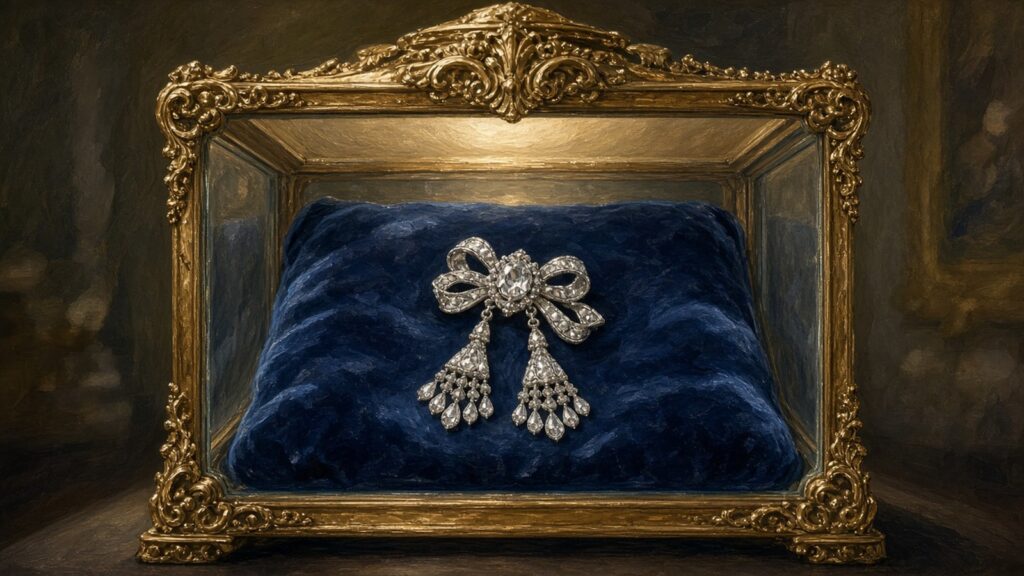
The bow was made to hold a belt together. In 1855 the jeweler François Kramer built it as the centrepiece of a belt for Empress Eugénie, set with Crown diamonds for the Exposition universelle in Paris. Within a decade it had become a brooch, and over the next 150 years it passed from an empress to a New York society queen, an English countess and a jewelry dealer before the Louvre bought it back in 2008 (Musée du Louvre). On October 19, 2025, thieves took it again.
The Collector’s Summary
Empress Eugénie’s bow brooch, the Grand nœud de corsage, is an 11-centimetre diamond bow made by François Kramer in 1855 and turned into a brooch in 1864. France sold it in 1887; it went to Caroline Astor, then to English aristocrats and a dealer, until the Louvre bought it for €6.72 million in 2008. It was stolen from the museum on October 19, 2025, and a year later it was still missing.
Jump to the timeline or what it teaches collectors.
What is Empress Eugénie’s bow brooch?
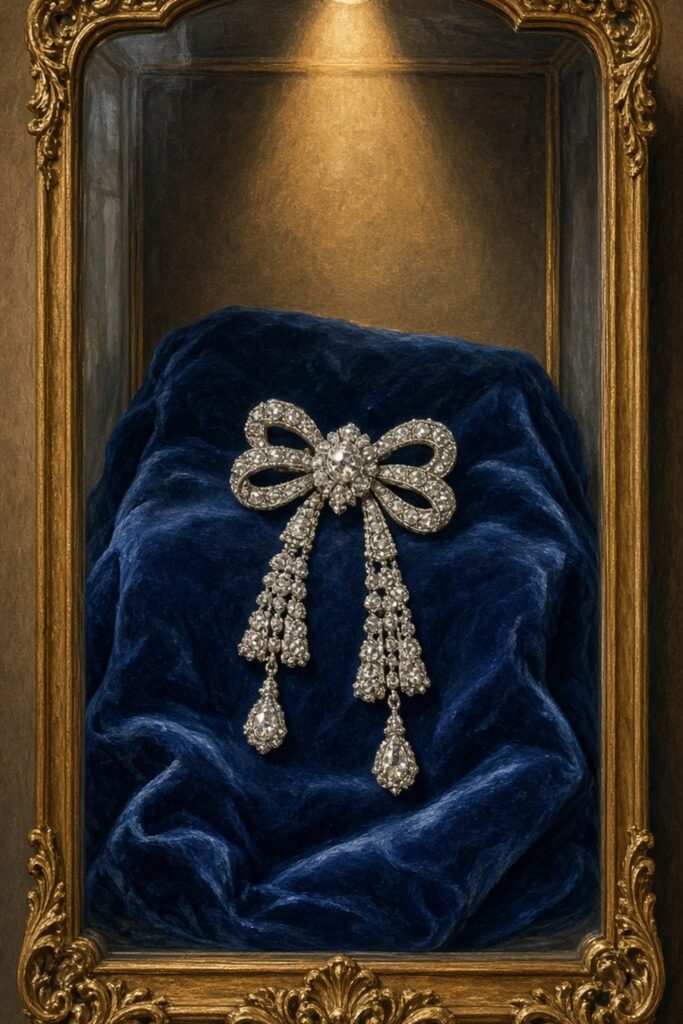
It is a large diamond bow with two tassels, made in 1855 by François Kramer as the centre of a belt set with more than 4,000 diamonds from the French Crown Jewels for the Exposition universelle. Eugénie wore it at Versailles on August 25, 1855, during Queen Victoria’s visit, and at the Hôtel de Ville on June 14, 1856, for the baptism of her son, the Prince Imperial. In 1864 it was converted into a corsage brooch (Musée du Louvre).
When the Louvre bought it, Le Nouvel Observateur gave its measurements: 11 centimetres wide, set with 2,634 diamonds, 196 rose-cut and 2,438 brilliant-cut, weighing more than 140 carats together. It was one of the Empress’s favourite jewels (Le Nouvel Obs).
How did the Eugénie brooch leave France?
France sold it. In May 1887 the Third Republic auctioned most of the Crown Jewels, and on May 12 the bow went as lot 5 to the dealer Emile Schlesinger, bidding for Caroline Astor, for 42,200 francs (Musée du Louvre, Christie’s). In New York it became known as “Mrs. Astor’s diamond stomacher,” worn by the hostess Christie’s credits with devising “the 400,” the list of New York society.
In 1902 the Duke of Westminster bought it for his sister, Lady Lettice Grosvenor, on her marriage to William Lygon, 7th Earl Beauchamp. It passed to Else Schiwe, 8th Countess Beauchamp, and around 1980 to the New York jewelry dealer Ralph Esmerian (Musée du Louvre).
How did the Louvre get the brooch back?
Through a cancelled auction. Christie’s had scheduled the bow for sale in New York on April 15, 2008, estimated at $4 million to $6 million. The sale was called off for judicial reasons, and Christie’s François Curiel negotiated a private sale to the Louvre instead (Christie’s, Le Journal des Arts). The museum paid €6.72 million, helped by a bequest of about €5 million (Le Nouvel Obs).
The courtroom part was a family matter. The New York Times reported that Esmerian’s sister, Jacqueline Esmerian King, claimed the brooch belonged to a family trust, and that Esmerian had filed for bankruptcy for his company, Fred Leighton Inc., on April 15 (The New York Times). The Louvre’s record lists the purchase through the Rouffet bequest, with the Société des Amis du Louvre and the Fonds du Patrimoine (Musée du Louvre).
Was the Eugénie bow brooch stolen from the Louvre?
Yes. On Sunday, October 19, 2025, thieves broke into the Louvre’s Apollo Gallery, which houses the Crown Jewels, and took eight pieces of the Crown Jewels. The Ministry of Culture’s list includes the “Grand nœud de corsage de l’Impératrice Eugénie (broche),” Eugénie’s diadem and a reliquary brooch; her crown was dropped during the escape and recovered (French Ministry of Culture).
A year later the jewels had not been found. France 24 reported on October 19, 2026, that four suspects were in custody awaiting trial and that the pieces, valued at about $100 million, were registered with Interpol; 20 Minutes put the estimate at €88 million (France 24, 20 Minutes). Eugénie’s damaged crown, set with 1,354 diamonds and 56 emeralds, was about to go into restoration (BFMTV).
The timeline
| Date | What happened | Source |
|---|---|---|
| 1855 | François Kramer makes the bow as the centre of Eugénie’s diamond belt for the Exposition universelle | Louvre |
| Aug 25, 1855 | Eugénie wears it at Versailles during Queen Victoria’s visit | Louvre |
| 1864 | Converted into a corsage brooch | Louvre |
| May 12, 1887 | Sold at the Crown Jewels auction, lot 5, to Emile Schlesinger for Caroline Astor | Louvre, Christie’s |
| 1902 | Bought by the Duke of Westminster for Lady Lettice Grosvenor’s marriage | Louvre |
| About 1980 | Acquired by Ralph Esmerian | Louvre |
| April 2008 | Christie’s auction cancelled; the Louvre buys it for €6.72 million | Christie’s, Nouvel Obs |
| Oct 19, 2025 | Stolen from the Louvre with seven other Crown Jewels | Ministry of Culture |
| Oct 19, 2026 | Still missing one year on; suspects awaiting trial | France 24 |
What the Eugénie bow teaches collectors
- A named provenance is a chain, not a label. The bow is traceable because every link, from the 1887 lot number to the 2008 committee decision, was written down. Keep the receipts, letters and appraisals that make your own chain.
- Ownership questions can stop a sale. The 2008 auction was cancelled over who had the right to sell. Before you buy a significant piece, ask who owns it and whether anyone else could claim it.
- Jewelry changes shape. A belt ornament became a brooch in 1864. Ask whether a piece has been altered, and when, because it changes both its story and its value.
- Insure and photograph. Detailed photographs and descriptions are what let stolen jewels be registered and recognized. Our care guide and authenticity checklist cover what to record.
Questions people ask
What is the Empress Eugénie brooch worth?
There is no current market value, because it belongs to the French state. The Louvre bought it for €6.72 million in April 2008, after Christie’s had estimated it at $4 million to $6 million. In 2026, reports valued all eight jewels stolen in 2025 together at about €88 million.
Who made Empress Eugénie’s bow brooch?
François Kramer, a Paris jeweler who worked for the Crown, made it in 1855 as the centre of a diamond belt for Empress Eugénie. It was converted into a brooch in 1864. The Louvre’s collection record credits the bow to him.
Has the Eugénie brooch been found?
Not as of October 2026. France 24 reported on the anniversary of the theft that the jewels stolen from the Louvre on October 19, 2025, were still missing and registered with Interpol, and that four suspects were in custody awaiting trial.
Is the Eugénie bow brooch the same as her reliquary brooch?
No. The bow brooch is the large diamond corsage bow from 1855. The reliquary brooch is a separate jewel. Both were in the Louvre’s Apollo Gallery, and both were among the eight pieces the Ministry of Culture listed as stolen on October 19, 2025, so reports often mention them together.
For a royal jewel bought rather than inherited, read the Poltimore Tiara.
Sources
- Musée du Louvre, collections record OA 12238, Grand nœud de corsage de l’impératrice Eugénie
- Christie’s, press release (Apr 22, 2008)
- Le Nouvel Obs, Un des derniers joyaux de la couronne de France rejoint le Louvre (Apr 22, 2008)
- Le Journal des Arts, Une vente de bijoux annulée chez Christie’s (2008)
- The New York Times, Family Feud Over Brooch (May 2, 2008)
- French Ministry of Culture, statement on the Louvre break-in (Oct 19, 2025)
- France 24, one year after the Louvre heist (Oct 19, 2026)
- 20 Minutes, Cambriolage du Louvre (Oct 19, 2026)
- BFMTV, the restoration of Eugénie’s crown (Oct 19, 2026)
- Town & Country, Louvre heist: French Crown Jewels missing one year later (2026)
Finely Owned is independent and isn’t affiliated with the Musée du Louvre, Christie’s or any jeweler named here.