

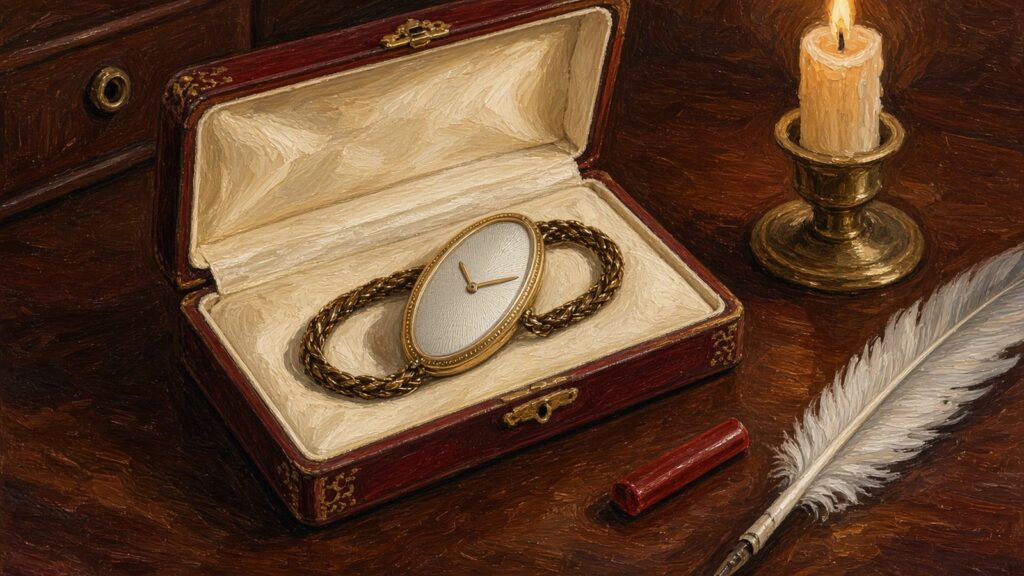
On June 8, 1810, Caroline Murat, Queen of Naples and youngest sister of Napoleon, ordered from Abraham-Louis Breguet “a repeater watch for bracelet” at 5,000 francs. It became Breguet No. 2639, the earliest known watch made from the start to be worn on the wrist (Breguet). Nobody knows where it is today. This is its story, told from Breguet’s own registers.
The Collector’s Summary
Breguet No. 2639 was an exceptionally thin, oval repeating watch with a thermometer, mounted on a bracelet of hair woven with gold thread. Caroline Murat ordered it in 1810 and it was finished on December 21, 1812. Her daughter sent it for repair in 1849 and again in 1855, the last time Breguet saw it. No public or private collection lists it.
Jump to the timeline or what it teaches collectors.
Who was Caroline Murat?
Napoleon’s youngest sister (1782–1839), who married Joachim Murat in 1800. They ruled as King and Queen of Naples from 1808 to 1815. She was Breguet’s most loyal patron in the Bonaparte family: from 1805, when she was 23, to 1814, the firm sold her no fewer than 34 watches and clocks (Breguet).
What did Breguet No. 2639 look like?
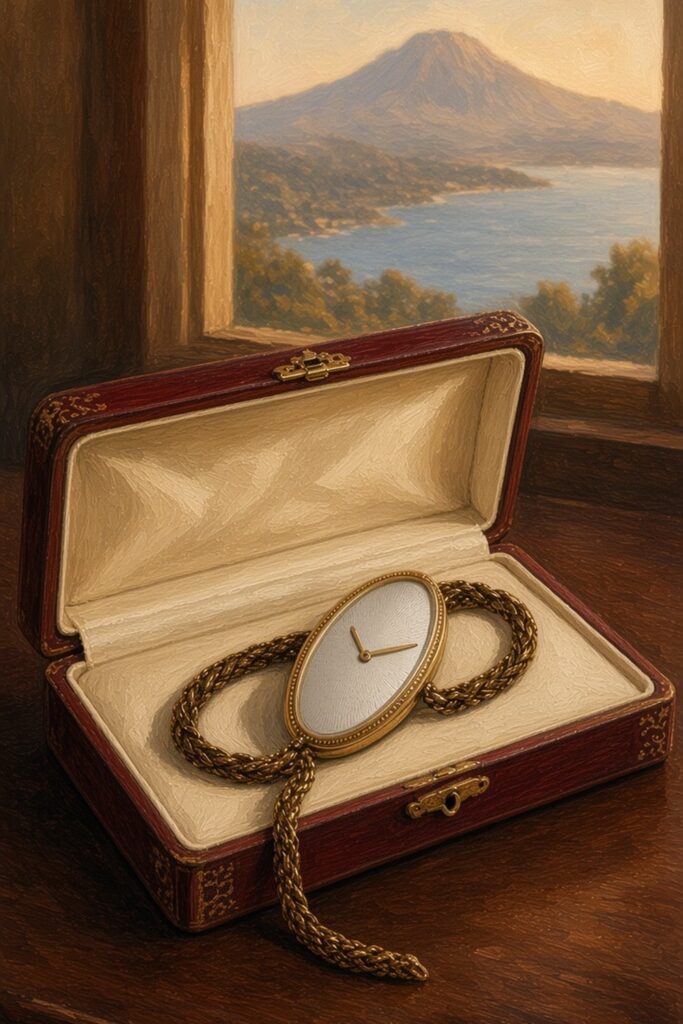
No drawing survives, so we only have words. Breguet’s registers describe a “very thin repeater watch,” oblong (meaning oval), with a silver guilloché dial, Arabic numerals, a thermometer and a fast/slow indicator outside the dial, on a wristlet of hair woven with gold thread (Breguet, Swatch Group). Its size and clasp are unknown.
Why did it take two and a half years?
Because Breguet would not deliver it until it was right. Work began on August 11, 1810. It was invoiced at 4,800 francs in December 1811, but then its motion work was replaced and its gold dial swapped for silver, probably at the Queen’s request. It was finished on December 21, 1812, when Joachim Murat was away fighting in Russia (Breguet).
Was it really the first wristwatch?
It is the first known watch designed to be worn on the wrist. Earlier watches were sometimes worn on bracelets, but No. 2639 was ordered “for bracelet” from the outset. Patek Philippe long cited a bracelet watch for the Hungarian Countess Kocewicz in 1868 as the first; Breguet’s commission came almost 60 years earlier (Breguet).
What happened to the Queen of Naples’ watch?
It disappeared after 1855. On March 8, 1849, Countess Rasponi, born Louise Murat, Caroline’s youngest child, sent it to Breguet for repair; it was returned on March 27 for 80 francs. In August 1855 she brought it back for new keys, the last trace in Breguet’s records (Swatch Group, Breguet). Breguet says no public or private collection lists it.
What is the Breguet Reine de Naples?
A women’s collection Breguet launched in 2002 in tribute to No. 2639. Its oval cases and off-center dials draw on the archive descriptions, and some models have a braided strap recalling the original’s wristlet (Swatch Group). In 2012 Breguet marked the watch’s bicentenary with events in Naples and Capri (La Cote des Montres).
The timeline
| Date | What happened | Source |
|---|---|---|
| 1805 | Caroline Murat buys her first Breguet | Breguet |
| June 8, 1810 | Orders “a repeater watch for bracelet” at 5,000 francs | Breguet |
| August 11, 1810 | Work begins on No. 2639 | Breguet |
| December 5, 1811 | Invoiced at 4,800 francs; changes still to come | Breguet |
| December 21, 1812 | Finished with a silver guilloché dial | Breguet |
| March 8–27, 1849 | Repaired for Countess Rasponi (Louise Murat) | Swatch Group |
| August 1855 | New keys; last trace in Breguet’s records | Swatch Group |
| 2002 | Breguet launches the Reine de Naples collection | Swatch Group |
| 2012 | Bicentenary events in Naples and Capri | La Cote des Montres |
What it teaches collectors
A maker’s archive can prove a watch existed long after the watch itself is gone. Everything we know about No. 2639 comes from Breguet’s order, production and repair registers. If a watch claiming to be No. 2639 ever surfaces, those registers are what it will be tested against. The same goes for any watch sold on its history: ask for an archive extract or a maker’s certificate, and start with our authenticity checklist.
Breguet’s other legendary lost-and-found commission is the Marie Antoinette watch. Browse the watches worth knowing and the maisons.
Questions people ask
Who made the first wristwatch?
Abraham-Louis Breguet made the first known watch designed to be worn on the wrist: No. 2639, ordered by Caroline Murat, Queen of Naples, in 1810 and finished in 1812. Patek Philippe long claimed the first with a bracelet watch for Countess Kocewicz in 1868, almost 60 years later.
Where is the Queen of Naples Breguet watch now?
No one knows. Breguet’s records show Caroline Murat’s daughter, Countess Rasponi, sent it for repair in 1849 and brought it back for new keys in 1855, the last trace. Breguet says no public or private collection lists it, so it may be lost, destroyed or unrecognized somewhere.
How much did the first wristwatch cost?
Breguet quoted Caroline Murat 5,000 francs in June 1810 and invoiced 4,800 francs in December 1811, slightly less than the quote. The watch still took another year to finish. Its repair in 1849, which included polishing the pivots and resetting the thermometer, cost 80 francs.
Is the Breguet Reine de Naples based on a real watch?
Yes. Breguet launched the Reine de Naples collection in 2002 as a tribute to No. 2639. Without any drawing of the original, the designers worked from archive descriptions, using an oval case, an off-center dial and, on some models, a braided strap that recalls the original’s wristlet of hair and gold thread.
For a Breguet with a different kind of owner, read Winston Churchill’s Breguet “Turnip”
For the watchmaker behind it, read Abraham-Louis Breguet
For another watch made for a queen, read Queen Elizabeth II’s Jaeger-LeCoultre
Sources
- Emmanuel Breguet, The First Wristwatch (Breguet, Quai de l’Horloge magazine)
- Swatch Group, Breguet: Bicentennial of the first wristwatch (October 2012)
- La Cote des Montres, Breguet celebrates the bicentennial of the first wristwatch
Finely Owned is independent and isn’t affiliated with Breguet or the Swatch Group.