

In the spring of 1969, in a suite at Caesars Palace in Las Vegas, Elizabeth Taylor reached for the pearl at her throat and found it gone. She searched the carpet on her hands and knees, then noticed one of her puppies chewing on something. “I just casually opened the puppy’s mouth,” she later wrote, “and inside his mouth was the most perfect pearl in the world” (JCK, BBC Culture). The pearl was La Peregrina, “the Pilgrim,” found in the Gulf of Panama in the sixteenth century and owned by eight Spanish kings. Richard Burton had bought it for $37,000. In 2011 it sold at Christie’s for $11,842,500. This is its history, told from the auction record, and what it means for anyone who owns or inherits a natural pearl today. For more jewelry stories, start with The Jewelry Worth Knowing.

The Collector’s Summary
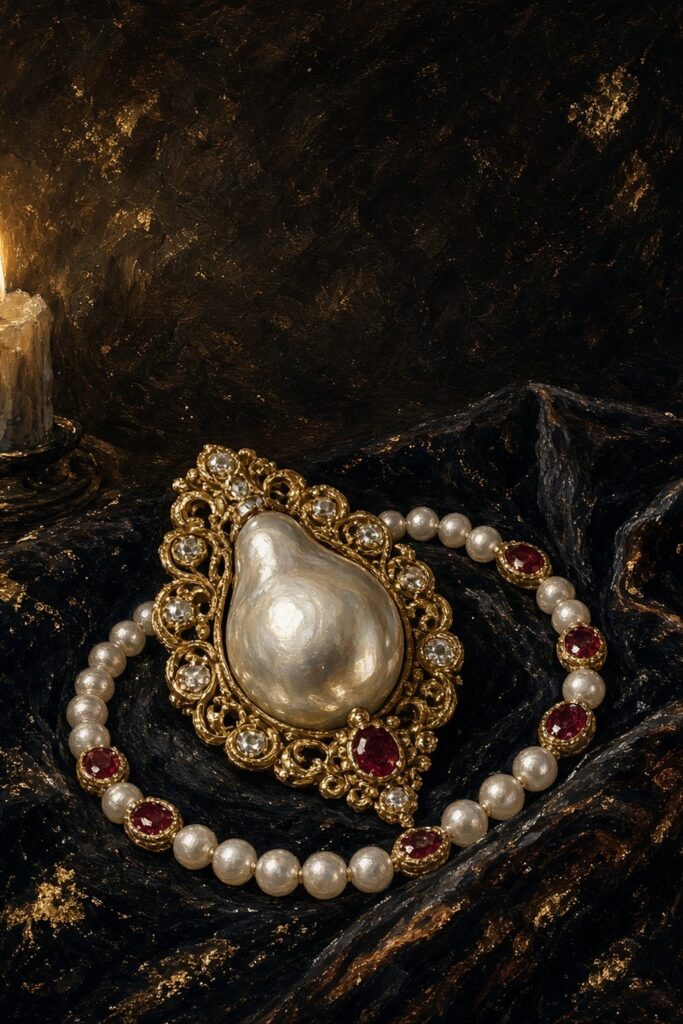
La Peregrina is a drop-shaped natural saltwater pearl of about 50.56 carats (202.24 grains), found in the Gulf of Panama in the 1500s. It belonged to the Spanish crown from 1582 to 1808, then to the Bonapartes and the Dukes of Abercorn. Richard Burton bought it for Elizabeth Taylor in January 1969, and Christie’s New York sold it, in a Cartier necklace she designed, for $11,842,500 on 13 December 2011.
Read the timeline of owners and what it teaches a pearl owner.
What is the La Peregrina pearl?
La Peregrina is one of the most famous natural pearls in the world: a symmetrical, pear-shaped saltwater pearl weighing about 202 grains, roughly 50.6 carats. Christie’s catalogued it as a late sixteenth-century pearl, with an old mine-cut and rose-cut diamond and silver bail added in the early nineteenth century (Christie’s). Its name means the Pilgrim or the Wanderer, which suits a pearl that crossed an ocean, moved between royal houses and was lost and found more than once (JCK).
Christie’s describes it as discovered in the 1500s in the Gulf of Panama and part of the crown jewels of Spain for generations (Christie’s). JCK records the traditional account that it was found by an enslaved man off the island of Santa Margarita, who was given his freedom for it (JCK, JCK). That story is part of the legend rather than the paperwork, and we repeat it as such.
La Peregrina pearl history: from the Spanish crown to Elizabeth Taylor
The table follows Christie’s list of ownership in the 2011 catalogue, with details from the sources noted.
| Years | Owner | What the record says |
|---|---|---|
| 1500s | Found in the Gulf of Panama | Sent straight to King Philip II of Spain (BBC) |
| 1582–1808 | Eight Spanish kings, Philip II to Carlos IV | Worn by Spanish queens in portraits by Velázquez (Christie’s via CIJ) |
| 1808–c.1844 | Joseph Bonaparte | Taken to France after the French left Spain in 1813 (BBC) |
| c.1844–c.1848 | Louis Napoleon, later Napoleon III | Inherited through his mother, Hortense de Beauharnais (BBC) |
| c.1848–1969 | The Dukes and Duchesses of Abercorn | Bought from Louis Napoleon; the Duchess reportedly lost it more than once (BBC) |
| 23 January 1969 | Elizabeth Taylor | Richard Burton buys it at Parke-Bernet, New York, for $37,000 (Christie’s) |
| 1972 | Elizabeth Taylor | Cartier makes the pearl, diamond and ruby necklace she designed with Al Durante (Christie’s) |
| 13 December 2011 | Undisclosed buyer | Sold for $11,842,500 after more than 20 bids, to a client on the telephone (CIJ) |
Did Mary Tudor own La Peregrina?
Probably not, and the confusion is a lesson in itself. For years La Peregrina was linked to Mary I of England, who wore a large drop pearl given to her on her marriage to Philip of Spain, and some accounts still say so (JCK). BBC Culture explains that Mary’s pearl was a different, similarly shaped jewel, and that Taylor and Burton once owned a 1554 portrait of Mary by Hans Eworth in the belief that it showed their pearl (BBC Culture). Christie’s own 2011 provenance list begins with Philip II in 1582, not with Mary (Christie’s). When two famous pearls share a shape and a century, the paper trail is what separates them.
How Richard Burton bought La Peregrina
Burton bought the pearl at Parke-Bernet Galleries in New York on 23 January 1969, for $37,000 (Christie’s, Christie’s). JCK reports that he outbid a member of the Spanish royal family, and that it was a Valentine’s gift (JCK). Ward Landrigan, who ran the auction house’s jewelry department and later owned Verdura, told JCK that he flew the pearl to Las Vegas himself, and that within twenty minutes of handing it over everyone in the room was on the pink shag carpet looking for it (JCK).
Taylor’s own account of the puppy, quoted by JCK from her book Elizabeth Taylor: My Love Affair with Jewelry, ends with the detail any pearl owner will understand: the pearl was, she wrote, “thank God, not scratched” (JCK).
Why did Elizabeth Taylor have La Peregrina reset by Cartier?
Because the pearl arrived on a thin chain, and she wanted a setting worthy of it. Christie’s notes that the lot still included the seed pearl and platinum chain from the 1969 purchase, alongside the two-strand Cartier necklace of 1972: fifty-six natural pearls and four cultured pearls, divided by diamond and ruby plaques, signed “Designed by Elizabeth Taylor with Al Durante of Cartier” (Christie’s). Christie’s said the design was inspired by a sixteenth-century portrait of Mary, Queen of Scots, while JCK points to Velázquez’s portraits of Spanish queens (CIJ, JCK). Either way, the pendant was made detachable, so it could also be worn as a brooch.
That is a quiet piece of good practice. The original bail, the original chain and the pearl itself were all kept, so the 1972 necklace added to the history instead of erasing it.
How much did La Peregrina sell for, and who owns it now?
It sold for $11,842,500, including the buyer’s premium, at The Collection of Elizabeth Taylor: The Legendary Jewels at Christie’s New York on 13 December 2011. The estimate was $2–3 million. Christie’s said it set world auction records for a historic pearl and for any pearl jewel (Christie’s), and Guinness World Records lists it as the most expensive pearl necklace sold at auction (Guinness). Bidding opened at $2 million and drew more than 20 bids before Rahul Kadakia, then head of jewelry for Christie’s Americas, took the winning bid from a client on the phone (CIJ).
Christie’s did not name the buyer, and we have found no reliable public record of who owns La Peregrina today. Anyone claiming otherwise should be able to show a source. Bloomberg noted that the evening sale of Taylor’s jewels made $115.9 million (Bloomberg).
What La Peregrina teaches anyone who owns a natural pearl
Few of us will own a royal pearl. Many of us will inherit a strand of pearls from a mother or grandmother, and the questions Christie’s answered for La Peregrina are the same ones worth asking of a family piece.
- Find out whether it is natural or cultured. Nearly all pearls sold today are cultured, formed with human help; natural pearls form without it and are far rarer (GIA). Even Taylor’s Cartier necklace mixed fifty-six natural pearls with four cultured ones, and the SSEF reports said so plainly (Christie’s). Only a laboratory, usually with X-ray imaging, can tell you which you have.
- Learn the words appraisers use. GIA judges pearls on size, shape, colour, lustre, surface quality, nacre quality and matching (GIA). A symmetrical drop like La Peregrina is valued partly because such shapes are rare.
- Keep the old fittings. Christie’s sold La Peregrina with its nineteenth-century bail and the chain from 1969. If you reset a family pearl, keep the old clasp and box in an envelope with the date; it is part of the record.
- Treat pearls as the softest thing in the jewelry box. GIA advises keeping pearls away from cosmetics, perfume and hairspray, wiping them after wear, and storing them apart from harder gems (GIA). Our guide to storing jewelry and handbags covers soft pouches and separate compartments.
- Write the story down. As an example, a strand worn at three family weddings means a great deal more with names, dates and a photograph kept beside it. Provenance is what turned a $37,000 pearl into an $11.8 million one.
Taylor was not the only owner whose name changed what a jewel was worth. Read the story of Princess Diana’s engagement ring, the Garrard sapphire that passed from mother to son, and Grace Kelly and the Hermès Kelly. Before you buy any pre-owned piece, our authenticity checklist lists the papers to ask for.
Questions people ask
What is the La Peregrina pearl?
La Peregrina is a natural saltwater drop-shaped pearl of about 50.56 carats, found in the Gulf of Panama in the 1500s. It belonged to eight Spanish kings, then to Joseph Bonaparte, Louis Napoleon and the Dukes of Abercorn, before Richard Burton bought it for Elizabeth Taylor in 1969.
How much did Richard Burton pay for La Peregrina?
He paid $37,000 at Parke-Bernet Galleries in New York on 23 January 1969, and gave it to Elizabeth Taylor as a Valentine’s gift.
How much did La Peregrina sell for in 2011?
It sold for $11,842,500 at Christie’s New York on 13 December 2011, against an estimate of $2 million to $3 million, setting a world auction record for a pearl jewel at the time.
Who owns La Peregrina now?
The current owner is not public. Christie’s sold it to a client bidding by telephone and did not name the buyer.
Did Elizabeth Taylor’s dog really chew La Peregrina?
Yes, by her own account. Soon after receiving it in 1969 she lost the pearl in a suite at Caesars Palace and found one of her puppies chewing it. She wrote that it was not scratched.
Did Mary Tudor wear La Peregrina?
Probably not. Mary I wore a similar drop pearl, but BBC Culture and the auction provenance indicate it was a different jewel, and La Peregrina’s recorded royal ownership begins with Philip II.
La Peregrina is not the only royal jewel that lost its king and found an American owner. Read the history of the Hope Diamond, Louis XIV’s French Blue, which Evalyn Walsh McLean wore for thirty-five years before Harry Winston mailed it to the Smithsonian.
La Peregrina left Spain with one Bonaparte; another Bonaparte gift took a different road. Read the story of the Napoleon Diamond Necklace, given to Empress Marie-Louise in 1811 and nearly lost to two impostors in New York in 1929.
La Peregrina is not the only royal jewel whose owners changed with a revolution. Read the story of the Grand Duchess Vladimir Tiara, the Romanov pearl-and-diamond tiara that became one of Queen Elizabeth II’s most familiar jewels.
For another famous piece with a film-star owner, read Grace Kelly’s Cartier Engagement Ring
For another Elizabeth Taylor jewel, read The Taylor-Burton Diamond
For another film star’s famous pearls, read Audrey Hepburn’s Breakfast at Tiffany’s Pearls
For another jewel from the same 2011 sale, read The Krupp Diamond
For another royal pearl with a record sale, read Marie Antoinette’s Pearl Pendant
Sources
- Christie’s, “La Peregrina: a natural pearl, diamond, ruby and cultured pearl necklace, by Cartier,” The Collection of Elizabeth Taylor, New York, 13 December 2011
- Christie’s press release, “The Legendary Jewels, December 13 & 14, 2011” (sale results)
- “Christie’s: La Peregrina makes history,” CIJ (Christie’s press text, December 2011)
- Matthew Wilson, “La Peregrina: The world’s most famous pearl,” BBC Culture (May 24, 2021)
- “The Too-Good-to-Be-True Tale of Liz Taylor’s $11.8 Million La Peregrina,” JCK
- “This Day in Jewelry History: Elizabeth Taylor Meets La Peregrina,” JCK
- “Liz Taylor’s $11.8 Million Dog-Chewed Pearl Tops Record Gem Sale,” Bloomberg (December 14, 2011)
- Guinness World Records, “Most expensive pearl necklace sold at auction”
- GIA, “Pearl” (description, history and care)
- GIA, “Pearl Quality Factors”
Finely Owned is independent and isn’t affiliated with Cartier, Christie’s, GIA or the estate of Elizabeth Taylor.