


The Sancy is a pale, pear-shaped diamond of about 55 carats that has been a French minister’s collateral, a jewel of the English crown, a cardinal’s bequest to Louis XIV and an American family’s heirloom. The Louvre bought it in 1976 (Louvre). This is the story of who owned it, and how it changed hands.
The Collector’s Summary
The Sancy is an asymmetrical pear-shaped diamond of about 55.23 carats, cut on both sides with 68 facets. Its first certain owner was Nicolas Harlay de Sancy, financier to Henri IV, who sold it to James I of England in 1604. Cardinal Mazarin bought it in 1657 and left it to the French crown. It was stolen in 1792, recovered, sold on, and bought by the Louvre from the Astor family in 1976.
Jump to the timeline or what it teaches collectors.
What does the Sancy diamond look like?
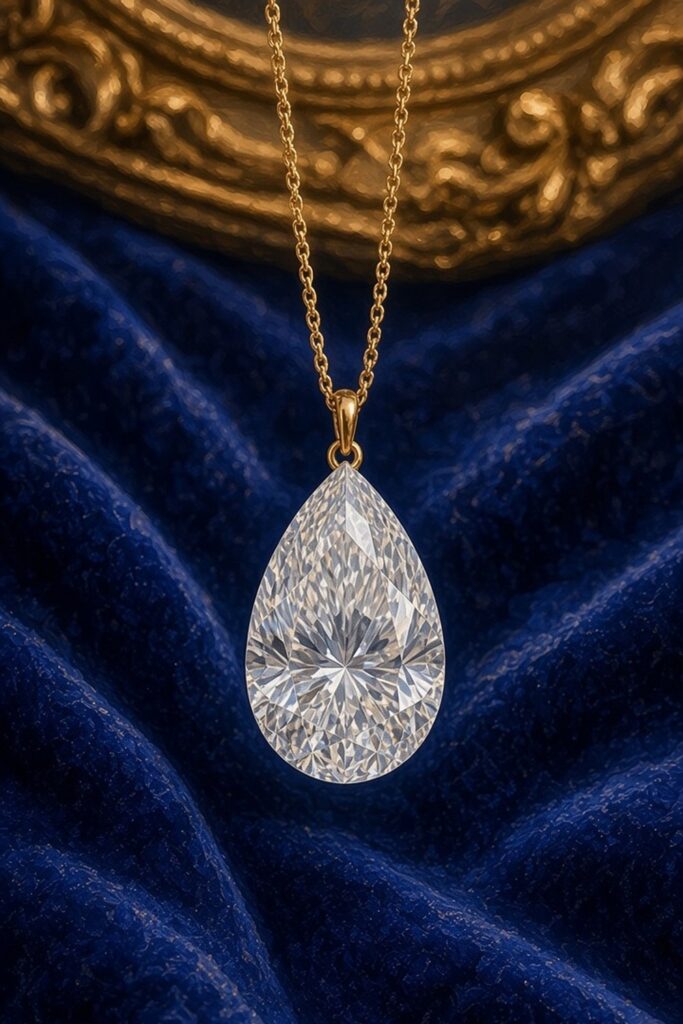
An asymmetrical pear, about 2.7cm by 2.1cm, faceted on both sides. The Louvre describes it as almost colorless with a very pale greenish-yellow edge, and attributes its star of 68 facets to a Paris lapidary of the second half of the 1500s (Louvre). Most references give its weight as 55.23 carats (Wikipedia).
Who was the first owner of the Sancy?
The first owner anyone can prove is Nicolas Harlay, sieur de Sancy (1546–1629), a diplomat and financier to Henri IV of France (Louvre). Earlier links to Charles the Bold and the Portuguese crown are unproven. Sancy pledged his gems to raise money for the crown, then sold them when he needed money himself (Lang Antiques).
How did the Sancy come to the English crown?
By sale. Sancy sold the diamond to James I of England in 1604, according to the Louvre’s record; English records describe the purchase in March 1605 (Louvre, Wikipedia). James set it in a jewel called the Mirror of Great Britain. It stayed with the Stuarts through the upheavals of the 1600s.
How did the Sancy return to France?
Through Cardinal Mazarin, chief minister of the young Louis XIV. He bought it in 1657, and it became the first of eighteen diamonds, called the “Mazarins,” that he left to the French crown jewels at his death in 1661 (Louvre). It stayed in the royal collection until the Revolution.
Was the Sancy stolen?
Yes. Thieves raided the royal Garde-Meuble in Paris between September 11 and 17, 1792, and the Sancy disappeared along with other crown jewels. It was recovered two years later, then pledged in Madrid by the Directory to raise money (Louvre). The French Blue, later recut into the Hope Diamond, was taken in the same raid.
Who owned the Sancy after the Revolution?
A Russian family, an Indian merchant and an American dynasty. The Louvre lists Nicolas Demidoff (1773–1828), then Sir Jamsetjee Jeejeebhoy (1811–1877), then William Waldorf Astor, later first Viscount Astor (Louvre). The Louvre dates the Astor purchase to 1892, while other accounts give 1906 (Wikipedia). The museum bought it from his great-grandson in 1976.
Is the Sancy in the Louvre now?
Yes, it belongs to the Louvre, though its collection record currently lists it as not on display (Louvre, checked November 2, 2026). It had been shown in the Galerie d’Apollon with the other crown jewels. In the October 2025 robbery there, the thieves did not take the Sancy (The Hindu).
The timeline
| Date | What happened | Source |
|---|---|---|
| Second half of the 1500s | Cut with 68 facets, attributed to a Paris lapidary | Louvre |
| Before 1604 | Owned by Nicolas Harlay, sieur de Sancy | Louvre |
| 1604–1605 | Sold to James I of England | Louvre |
| 1657 | Bought by Cardinal Mazarin | Louvre |
| 1661 | Bequeathed to the French crown jewels | Louvre |
| September 1792 | Stolen from the Garde-Meuble | Louvre |
| About 1794 | Recovered; later pledged in Madrid | Louvre |
| 1800s | Demidoff family, then Sir Jamsetjee Jeejeebhoy | Louvre |
| 1892 (some say 1906) | Bought by William Waldorf Astor | Louvre |
| 1976 | Bought by the Louvre from the Astor family | Louvre |
| October 2025 | Left behind in the Galerie d’Apollon robbery | The Hindu |
What it teaches collectors
Even the world’s best-documented diamonds have gaps and conflicting dates, and the Sancy has both. Notice what the Louvre does: it names the first owner it can prove and treats the older legends separately. Do the same with any piece sold on its history. Ask which owners are documented and which are only said to have owned it, and start with our authenticity checklist.
Compare it with the Koh-i-Noor, La Peregrina and the Hope Diamond, or browse the jewels worth knowing and the maisons.
Questions people ask
How much is the Sancy diamond worth?
No one can say. The Sancy belongs to the French state and the Louvre, and it has not been sold since the museum bought it from the Astor family in 1976, so there is no current market price. Its value comes from about 55 carats of rare, early cutting and four centuries of documented royal owners.
Where is the Sancy diamond now?
It belongs to the Louvre in Paris, inventory number OA 10630. It was displayed in the Galerie d’Apollon with the other French crown jewels, but the museum’s collection record listed it as not on display when we checked on November 2, 2026. It was not taken in the October 2025 robbery.
Is the Sancy diamond cursed?
There is no evidence of a curse. The Sancy has a dramatic history, with royal debts, a revolutionary theft and many sales, and some books call it cursed or a blood diamond. The documented record shows a valuable stone sold whenever its owners needed money, not a pattern of misfortune.
Is the Sancy the same as the Beau Sancy?
No. The Beau Sancy is a different, smaller diamond that Nicolas Harlay de Sancy also owned. The Sancy in the Louvre is the larger stone of about 55 carats that he sold to James I of England, which later returned to France through Cardinal Mazarin.
For a crown diamond that went east instead of west, read The Orlov Diamond
For the diamond the Regent outshone, read The Regent Diamond
For another French crown diamond, read The Hortensia Diamond
Sources
- Musée du Louvre, collections record: Diamant dit “Le Sancy,” OA 10630
- Lang Antiques, Sancy Diamond
- Notes Upon the Owners of the “Sancy” Diamond (Wikisource)
- Wikipedia, Sancy
- The Hindu, When the Louvre thieves missed the diamonds from Golconda (October 2025)
Finely Owned is independent and isn’t affiliated with the Musée du Louvre.