
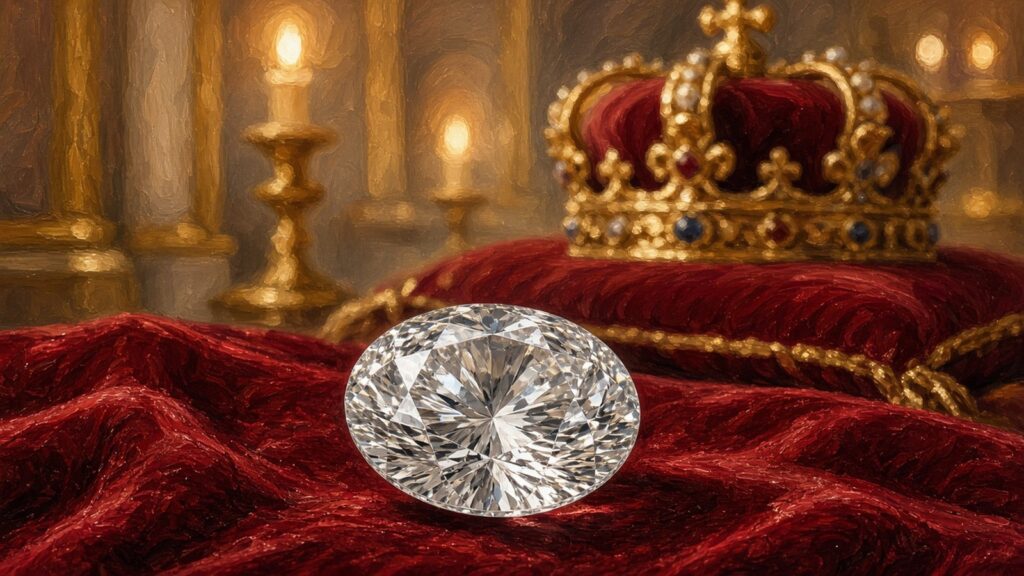
The Koh-i-Noor, Persian for “Mountain of Light,” has passed through the hands of Mughal emperors, a Persian conqueror, an Afghan king, a Sikh maharaja and Queen Victoria. Today it weighs 105.6 carats and sits in the front cross of a crown in the Tower of London, and it is still claimed by India (Britannica, Royal Collection Trust). This is the story of who owned it, and how.
The Collector’s Summary
The Koh-i-Noor is a 105.6-carat oval diamond in the British Crown Jewels. Its early history is debated, but its documented line of owners runs through the Mughals, Nader Shah of Persia, the Durrani rulers of Afghanistan and Maharaja Ranjit Singh. It passed to Britain under the 1849 Treaty of Lahore, was recut in 1852 and has been set in the crown of Queen Elizabeth The Queen Mother since 1937.
Jump to the timeline or what it teaches collectors.
Where did the Koh-i-Noor come from?
Nobody knows for certain. Britannica notes that it may have come from the Kollur mine on the Krishna River in southern India, and that its early history is tangled in legend. Some historians say Sultan Ala al-Din Khalji took it from the raja of Malwa in 1304. Others identify it with a diamond given to the son of Babur, founder of the Mughal dynasty, after the battle of Panipat in 1526, or with a stone presented to Shah Jahan in 1656. None of these links can be proved (Britannica).
Who owned the Koh-i-Noor?
The firmer record begins in 1739, when Nader Shah of Persia sacked Delhi and carried the Mughal treasury away, the diamond with it. After his murder it went to Ahmad Shah Durrani, founder of the Afghan Durrani state. His descendant Shah Shuja, deposed and in exile, surrendered it in Lahore to Maharaja Ranjit Singh, ruler of the Sikh Empire (Britannica, Historic Royal Palaces).
How did the Koh-i-Noor come to Britain?
Through a treaty that ended a war. After Ranjit Singh’s death and the Anglo-Sikh wars, the East India Company annexed the Punjab in 1849. The Treaty of Lahore required that the gem “called the Koh-i-Noor” be surrendered by the Maharaja of Lahore to the Queen of England. That Maharaja was Duleep Singh, a boy of about ten (Historic Royal Palaces, Britannica). The diamond was presented to Queen Victoria in 1850 (V&A).
Why was the Koh-i-Noor recut?
Because the public found it disappointing. Shown at the Great Exhibition of 1851, the old Mughal cut looked dull under the lights, and the press said so. In 1852 Prince Albert had it recut by Garrard into the oval brilliant we know, bringing it down from about 191 carats to 105.6 (V&A, Britannica). Queen Victoria wore it as a brooch.
Which crown has the Koh-i-Noor?
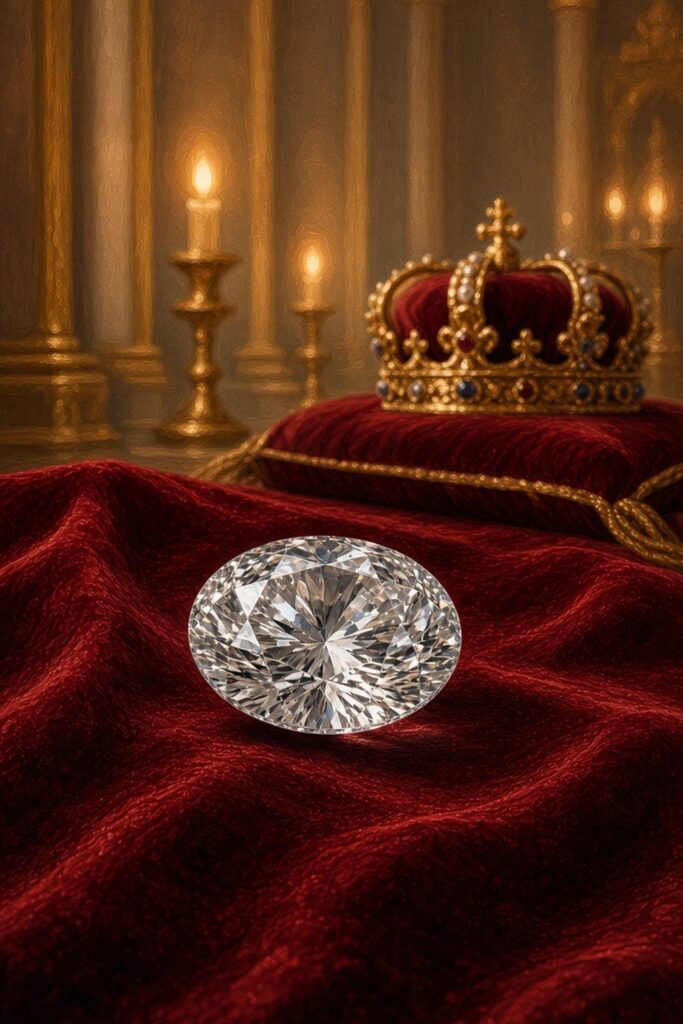
The platinum crown made in 1937 for Queen Elizabeth, consort of George VI and later the Queen Mother. It holds about 2,800 diamonds, with the Koh-i-Noor in the front cross. The diamond was earlier set in the crowns of Queen Alexandra and Queen Mary. The Queen Mother wore this crown at the 1937 coronation, at State Openings of Parliament and at the 1953 coronation of her daughter (Royal Collection Trust). It rested on her coffin in 2002 (Britannica).
Is the Koh-i-Noor disputed?
Yes. India has repeatedly demanded its return, it is claimed by several other countries, and the monarchy has limited how it is used (Britannica). At the 2023 coronation Queen Camilla wore Queen Mary’s crown instead of the Queen Mother’s, and the Tower of London’s new display that year described the diamond as a symbol of conquest (The Telegraph).
The timeline
| Date | What happened | Source |
|---|---|---|
| Before 1739 | Early history debated; possible links to Khalji (1304), Babur’s son (1526) and Shah Jahan (1656) | Britannica |
| 1739 | Nader Shah sacks Delhi and takes the Mughal treasury | Britannica |
| After 1747 | Passes to Ahmad Shah Durrani of Afghanistan | Britannica |
| Early 1800s | Shah Shuja surrenders it to Maharaja Ranjit Singh in Lahore | Historic Royal Palaces |
| 1849 | Treaty of Lahore; surrendered by Duleep Singh to the Queen | Historic Royal Palaces |
| 1850 | Presented to Queen Victoria | V&A |
| 1851 | Shown at the Great Exhibition, to disappointment | V&A |
| 1852 | Recut by Garrard to 105.6 carats | Britannica |
| 1937 | Set in the new crown of Queen Elizabeth | Royal Collection Trust |
| 2002 | The crown rests on the Queen Mother’s coffin | Britannica |
| 2023 | Not used at the coronation; Tower display calls it a symbol of conquest | The Telegraph |
What it teaches collectors
The Koh-i-Noor has never been sold on the open market, so it has no price, only a history. That history is the lesson: for any famous stone, the question isn’t just “Is it real?” but “How did each owner come to hold it?” Provenance includes how a piece changed hands, and a gap or a forced transfer can follow it for centuries. When you buy a piece sold on its history, ask for the paperwork behind every link in the chain, and start with our authenticity checklist.
Compare it with the Cullinan, the largest diamond in the Crown Jewels, and the Hope Diamond, or browse the jewels worth knowing.
Questions people ask
How much is the Koh-i-Noor diamond worth?
It has no market value anyone can quote. The Koh-i-Noor has never been sold on the open market and belongs to the British Crown Jewels, so any figure you see is a guess. Its 105.6 carats are only part of its importance; most of it comes from its history.
Where is the Koh-i-Noor diamond now?
It is in the Jewel House at the Tower of London, set in the front cross of the crown made in 1937 for Queen Elizabeth, later the Queen Mother. The crown holds about 2,800 diamonds, and the Koh-i-Noor is the largest of them.
Why does India want the Koh-i-Noor back?
India sees the diamond as taken from the Punjab under the 1849 Treaty of Lahore, when the ruler, Duleep Singh, was a child and the East India Company had annexed his kingdom. India has demanded its return several times, and several other countries have also claimed it.
Did Queen Camilla wear the Koh-i-Noor?
No. At the 2023 coronation Queen Camilla wore Queen Mary’s crown, reset for the occasion, rather than the Queen Mother’s crown with the Koh-i-Noor. Buckingham Palace had announced beforehand that the Koh-i-Noor would not feature in the ceremony.
For another historic diamond with a long chain of owners, read The Sancy Diamond
For another great Indian diamond in a royal collection, read The Orlov Diamond
Sources
- Encyclopaedia Britannica, Koh-i-noor
- Royal Collection Trust, Queen Elizabeth The Queen Mother’s Crown
- Victoria and Albert Museum, Henry Cole and the Koh-i-Noor diamond
- Historic Royal Palaces, Symbols of Power: key characters (PDF)
- The Telegraph, Koh-i-Noor diamond described as a symbol of conquest (May 2023)
- GIA, British royal jewels: beautiful and historic
Finely Owned is independent and isn’t affiliated with the Royal Collection Trust or Historic Royal Palaces.