

In the summer of 1917, an English antiques dealer in his fifties put on workman’s clothes, slipped through a side door of an empty palace on the Neva, and emptied a safe. He wrapped the jewels in old newspaper, packed them into two shabby Gladstone bags and, that autumn, carried them across a mined North Sea to Aberdeen (Sotheby’s catalogue, via Euro History Journal). The first item on the inventory a London jeweler later made of that haul was a diamond tiara of fifteen interlaced circles, each hung with a pearl, “four pearls missing and 3 brilliants loose” (Sotheby’s). Within three years its owner, the Grand Duchess Vladimir, was dead. A queen bought it from her daughter, and another queen wore it for almost seventy years. This is the story of the Grand Duchess Vladimir Tiara through the people who kept it, and what it teaches anyone who owns a jewel that comes apart. For more jewelry stories, start with The Jewelry Worth Knowing.
The Collector’s Summary
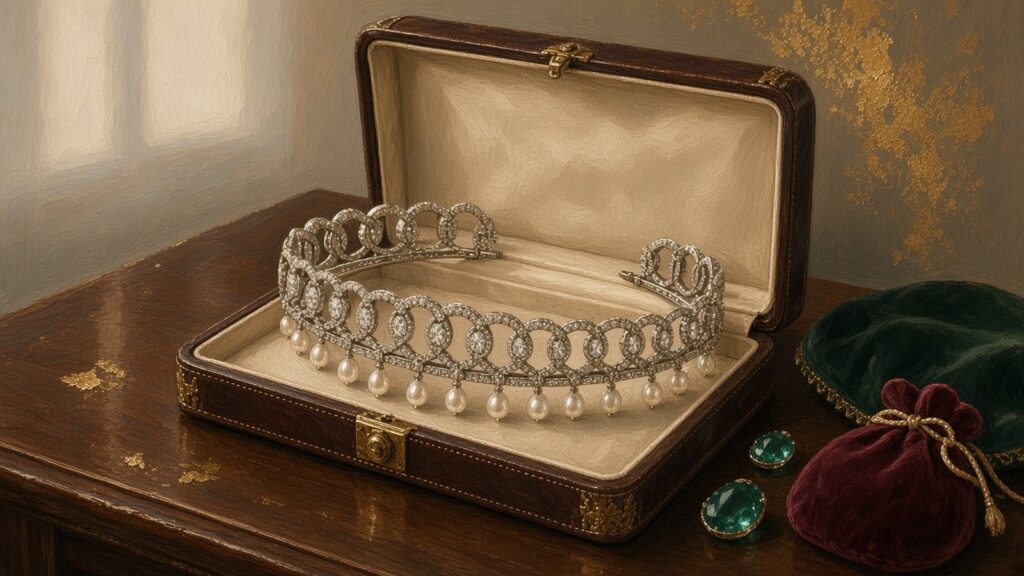
The Grand Duchess Vladimir Tiara is a Russian diamond tiara of fifteen interlaced circles that can hold fifteen pearl drops, fifteen cabochon emerald drops, or nothing at all. It belonged to Grand Duchess Maria Pavlovna of Russia, was smuggled out of revolutionary Petrograd by her friend Albert Stopford in 1917, and was sold by her daughter to Queen Mary in 1921. Queen Elizabeth II inherited it in 1953 and wore it until 2019 (The Court Jeweller).
Read the timeline of owners and what it teaches anyone with a convertible jewel.
Who was the Grand Duchess Vladimir?
She was born Duchess Marie of Mecklenburg-Schwerin, a German princess, and in 1874 she married Grand Duke Vladimir Alexandrovich, a son of Emperor Alexander II. She took the name Maria Pavlovna, her family called her “Miechen,” and the rest of the world called her the Grand Duchess Vladimir (The Court Jeweller). At the Vladimir Palace in Saint Petersburg the couple kept what amounted to a rival court of writers, artists and aristocrats, and her jewels were famous: she was sometimes called the “grandest of Grand Duchesses” (Mistress of the Robes, Tatler).
Who made the Vladimir Tiara, and when?
The house was Bolin, jewelers to the Russian court. The date is less certain than most accounts suggest. For years the tiara was described as a wedding-time gift to Maria Pavlovna around 1874 (The Court Jeweller). In 2023, the historians Galina Korneva and Tatiana Cheboksarova published research from the Russian State Historical Archive suggesting it was probably made by Bolin for her mother-in-law, Empress Maria Alexandrovna, and passed to Grand Duke Vladimir when the empress died in 1880 (The Court Jeweller, 2026). Either way, it was hers for more than forty years.
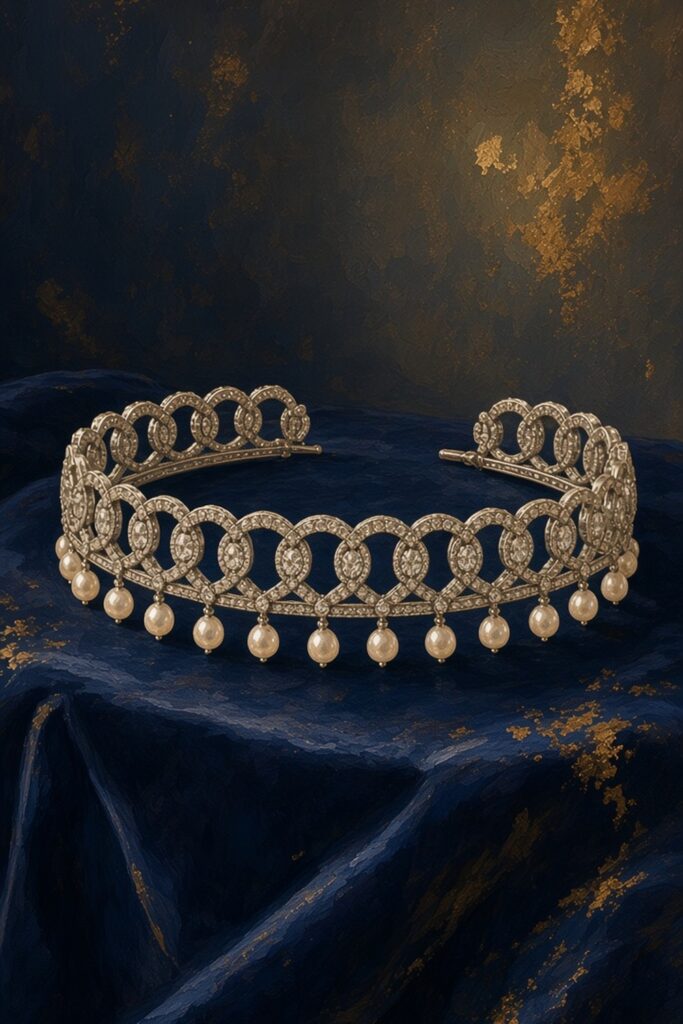
It was built to change. The pearls could be removed, and so could part of the diamond frame, so the tiara could be worn as a smaller closed coronet. Without its drops it is called “widowed” (The Court Jeweller).
How was the Vladimir Tiara smuggled out of Russia?
After the Tsar abdicated in 1917, Maria Pavlovna was advised to leave Petrograd and went south to her villa at Kislovodsk, a spa town in the Caucasus. Her jewels stayed behind in a hidden safe in her rooms at the Vladimir Palace (The Court Jeweller). Albert Stopford, known as Bertie, was a British antiques and art dealer, a friend who saw her almost daily when they were both in the city, and a semi-official courier for the British embassy (Sotheby’s, Wikipedia).
According to the Sotheby’s catalogue, her son Grand Duke Boris and a trusted servant let Stopford in through a side door. He took the jewels apart, folded them into newspaper, and carried the money from the safe to her at Kislovodsk; in his diary he wrote that they counted the notes he had brought “in my boots.” Accounts differ on whether Boris went into the palace with him (BBC Russian). Stopford left for London on 26 September 1917 and reached Aberdeen on 6 October, “delighted to see policemen again” (Sotheby’s). The jewels went into a London bank, Cox & Co. (Sotheby’s). Most accounts put the haul at 244 pieces (Wikipedia, The Telegraph); the Garrard inventory of January 1920 lists 115 (Sotheby’s).
His own story did not end well. Within months of his return he was tried at the Old Bailey under the laws of the time against homosexuality and served time in Wormwood Scrubs in 1918 and 1919. He left England in 1920, never returned, and died in 1939; he is buried at Bagneux, outside Paris (Wikipedia).
What happened to the Grand Duchess after 1917?
She stayed in Russia as long as she could. Stopford wrote to her bank that “she will never leave Russia unless deported by force” (Sotheby’s). In February 1920 she became the last Romanov to escape, on an Italian steamer bound for Venice, where Stopford met her (The Court Jeweller, Wikipedia). In letters to her London bank in 1919 and 1920 she wrote of her relief that the jewels were safe, asked for an advance of £10,000, and sent Pierre Cartier to value them (Sotheby’s). The journey had broken her health, and she died in France in September 1920 (Mistress of the Robes).
She had not told everyone everything. In November 1918 another group of her valuables, Fabérge cigarette cases and cufflinks, had been deposited at the Swedish legation in Petrograd (Sotheby’s). She died without telling her family, and the cache sat in the Swedish Foreign Ministry for about ninety years (SVT). When it was found and sold at Sotheby’s in London on 30 November 2009, it brought £7,073,300 (ArtNews).
How did Queen Mary buy the Vladimir Tiara?
The tiara passed to Maria Pavlovna’s only daughter, Elena, who had married Prince Nicholas of Greece and was living in exile (The Court Jeweller). In 1921 she sold some of her mother’s jewels. Queen Mary, the wife of King George V and a determined collector, bought the tiara; The Telegraph gives the price as £28,000, and Mistress of the Robes says that sum also covered a diamond rivière. Queen Marie of Romania and Nancy Leeds bought other pieces (Tatler).
Queen Mary had Garrard repair the damage from the journey, and in 1924 had it adapted again to take fifteen cabochon emerald drops from the Cambridge emeralds, stones from her own mother’s family (The Court Jeweller). From then the tiara had three looks: pearls, emeralds or bare. She wore the new version to the State Opening of Parliament in December 1924 (Mistress of the Robes).
How often did Queen Elizabeth II wear the Vladimir Tiara?
Often enough that it became one of the jewels most associated with her. Queen Mary died in 1953 and the tiara went to her granddaughter, who first wore it that October to a Royal Command Film Performance in Leicester Square (The Court Jeweller). She chose it for state visits and banquets for decades, switching pearls for emeralds as the occasion required (The Telegraph). Her dresser Angela Kelly has written that changing the drops can take up to an hour, and that the stones are kept in numbered velvet bags beside the tiara’s fitted leather case (Mistress of the Robes).
One evening in July 1963 tied the story together. The Queen wore the tiara to a gala at Covent Garden during the Greek state visit, and in the row behind her stood Princess Marina, Duchess of Kent, the daughter of Princess Nicholas and granddaughter of the Grand Duchess Vladimir (The Court Jeweller). In 1988 the tiara, worn so often, was given an entirely new frame by Garrard (The Court Jeweller, Mistress of the Robes).
Where is the Vladimir Tiara now?
It remains with the British royal family. It was the last tiara Queen Elizabeth II was pictured wearing in public, with its emeralds, at the Diplomatic Reception at Buckingham Palace on 11 December 2019 (The Court Jeweller). In September 2023, for the first anniversary of her death, the royal family released a Cecil Beaton portrait of her wearing it (Tatler). We could find no report of anyone wearing it in public since 2019. Only three women are known to have worn it publicly: the Grand Duchess Vladimir, Queen Mary and Queen Elizabeth II (The Court Jeweller).
The Grand Duchess Vladimir Tiara: a timeline of owners
| Year | Owner or event | Source |
|---|---|---|
| 1840s–1880 | Possibly made by Bolin for Empress Maria Alexandrovna and left to Grand Duke Vladimir (2023 archive research) | The Court Jeweller |
| 1874 | Marie of Mecklenburg-Schwerin marries Grand Duke Vladimir and becomes Maria Pavlovna; traditional date for the tiara | The Court Jeweller |
| 1917 | Stopford retrieves her jewels from the Vladimir Palace; reaches Aberdeen on 6 October | Sotheby’s |
| 1918 | Other valuables deposited at the Swedish legation in Petrograd | Sotheby’s |
| 1920 | Garrard inventory in London: “four pearls missing and 3 brilliants loose” | Sotheby’s |
| 1920 | Maria Pavlovna escapes in February and dies in France in September; her daughter Elena inherits | The Court Jeweller |
| 1921 | Queen Mary buys the tiara, reportedly for £28,000 | The Telegraph |
| 1924 | Garrard adapts it to take fifteen Cambridge emerald drops | The Court Jeweller |
| 1953 | Queen Elizabeth II inherits it and first wears it in October | The Court Jeweller |
| 1988 | Garrard builds an entirely new frame | The Court Jeweller |
| 2009 | The forgotten Stockholm cache sells at Sotheby’s London for £7,073,300 | ArtNews |
| 2019 | Last tiara Elizabeth II is pictured wearing in public (11 December) | The Court Jeweller |
What the Vladimir Tiara teaches anyone with a convertible jewel
Few of us will own a tiara. Plenty of us own a jewel with parts: earrings with detachable drops, a necklace that becomes a bracelet, a brooch that clips onto a pendant. The tiara’s history shows what keeps those pieces whole.
- Keep every part together, and label it. The tiara’s drops live in numbered bags beside its case (Mistress of the Robes). Keep the removable parts, the fitting tools and any spare links in one box, with a note of which part goes where.
- Inventory before and after a move. Garrard’s 1920 list recorded exactly what had gone missing on the journey (Sotheby’s). Photograph a piece and list its stones before shipping or storing it, and check it again on arrival. Our authenticity checklist lists the records worth keeping.
- Get a written valuation from a specialist. Even in exile, the Grand Duchess had Pierre Cartier value her jewels before borrowing against them (Sotheby’s). An insurance appraisal in writing, updated every few years, protects you and your heirs.
- Record every repair and alteration. This tiara was repaired in 1921, adapted in 1924 and given a new frame in 1988 (The Court Jeweller). Each change is part of its history. Keep the jeweler’s invoice, a description of the work, and any original parts that were replaced.
- Say what you don’t know. Even a tiara this famous has a disputed origin (The Court Jeweller). When you write down a family piece’s history, separate what documents show from what the family remembers.
- Tell someone where everything is. The Grand Duchess died without telling her family about the Stockholm deposit, and it stayed lost for ninety years (SVT). A short letter naming each piece, where it is kept and who should have it does more than any safe.
Pearl drops need particular care: they are softer than diamonds and can be scratched by them, so store them apart. Our guide to storing fine jewelry covers how. For other royal jewels with long paper trails, read the story of Princess Diana’s engagement ring, another Garrard piece, or La Peregrina, the pearl that passed through the Spanish crown.
Questions people ask
Who owns the Grand Duchess Vladimir Tiara?
It remains with the British royal family. Queen Mary bought it in 1921 from Grand Duchess Elena Vladimirovna, Princess Nicholas of Greece, and Queen Elizabeth II inherited it from her grandmother in 1953.
How much is the Vladimir Tiara worth?
No current valuation has been published, and it has never been sold at auction. Queen Mary reportedly paid £28,000 for it in 1921; one account says that price also covered a diamond rivière.
How was the Vladimir Tiara smuggled out of Russia?
In 1917 Albert Stopford, a British antiques dealer and friend of the Grand Duchess, entered the Vladimir Palace in workman’s clothes with the help of her son Grand Duke Boris and a servant, took her jewels from a hidden safe, and carried them to London in two Gladstone bags.
Why does the Vladimir Tiara have emeralds?
In 1924 Queen Mary had Garrard adapt the tiara so that fifteen cabochon emerald drops from the Cambridge emeralds could replace its fifteen pearls. It can also be worn with no drops, which is called widowed.
When did Queen Elizabeth II last wear the Vladimir Tiara?
On 11 December 2019, at the Diplomatic Reception at Buckingham Palace, with its emerald drops. It was the last tiara she was pictured wearing in public.
Another royal tiara with an auction story: the Poltimore Tiara, Princess Margaret’s wedding tiara.
Sources
- The Court Jeweller, “The Vladimir Tiara” (27 July 2019)
- Lauren Kiehna, The Court Jeweller, “From Romance to Revolution: The Vladimir Tiara” (30 May 2026), citing Korneva and Cheboksarova, Jewellery History Today (2023)
- Sotheby’s, letters and documents of the Grand Duchess Vladimir, including the Garrard inventory of 26 January 1920 (2011, lot 78)
- Euro History Journal, “Grand Duchess Maria Pavlovna of Russia’s Jewels at Auction in Geneva” (November 2021), quoting the Sotheby’s Geneva catalogue
- Sotheby’s, “Romanov Heirlooms: The Lost Inheritance of Grand Duchess Maria Pavlovna,” London, 30 November 2009
- Sotheby’s announcement via Auction Publicity, “Sotheby’s to Auction a Lost Inheritance of the Romanovs” (8 July 2009)
- ArtNews, “Sotheby’s London Sale of Rediscovered Fabérge Totals $11.6 Million” (2009)
- SVT Nyheter, “Miljonskatt hittad i UD:s arkiv” (28 August 2009)
- BBC Russian, on William Clarke’s Hidden Treasures of the Romanovs (30 June 2009)
- The Telegraph, “Queen Elizabeth’s most spectacular jewellery”
- Tatler, “The fascinating history of the Vladimir Tiara” (8 September 2023)
- Mistress of the Robes, “A Royal Favourite: The Vladimir Tiara” (27 March 2025)
- Wikipedia, “Albert Stopford”
Finely Owned is independent and isn’t affiliated with the Royal Collection Trust, the royal household, Garrard, Cartier or Sotheby’s.