

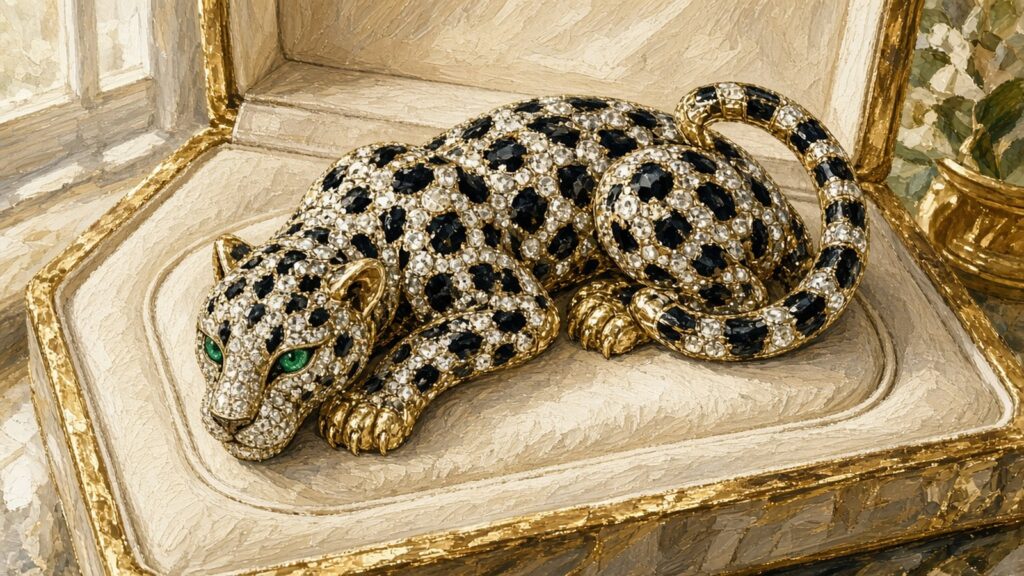
In December 1952, the Duchess of Windsor bought a bracelet from Cartier in Paris in the shape of a panther: a long, supple cat in diamonds and onyx, with emerald eyes, built to wrap around the wrist as if it were stalking something. Cartier’s records, Sotheby’s later noted, show the sale was made to the Duchess herself rather than to her husband, the former King Edward VIII (Sotheby’s). In 2010 that bracelet sold in London for £4,521,250, then the highest price ever paid for a bracelet at auction and for any Cartier jewel (The Guardian). This is the story of Wallis Simpson’s panther, told from the auction record, and what its condition report teaches anyone who owns or inherits a vintage piece. For more jewelry stories, start with The Jewelry Worth Knowing.
The Collector’s Summary
Wallis Simpson’s panther bracelet is an onyx and diamond Cartier bracelet made in Paris in 1952, set with about 15 to 16 carats of diamonds and marquise-shaped emerald eyes, in platinum and 18-carat gold. It sold at Sotheby’s London on 30 November 2010 for £4,521,250 against an estimate of £1–1.5 million, and Sotheby’s press office said the buyer was the Cartier Collection.
What is the Wallis Simpson panther bracelet?
It is a fully articulated bracelet in the form of a panther, its body pavé-set with diamonds and spotted with calibré-cut onyx, its eyes two marquise emeralds. Sotheby’s describes it as designed “to encircle the wrist and to assume a stalking attitude,” with a wearing length of about 165mm and joints so supple that its condition report calls it “extremely flexible” (Sotheby’s). The cat opens in two places, under the head and at the centre of the back, which is how it is put on.
Sotheby’s says the most striking thing about the piece is not only its realism but its “supple highly articulated linking allowing it to move very elegantly” (Sotheby’s). That movement is the hardest thing in the bracelet to make, and the first thing to wear.
How did the Duchess of Windsor come to own Cartier panthers?
Through Jeanne Toussaint, Cartier’s creative director from 1933, who was nicknamed “La Panthère” in Paris and made the animal her signature. Cartier says that in 1948 Toussaint gave the panther a three-dimensional body for the first time, perched on an emerald cabochon, in a brooch commissioned for the Duchess (Cartier, Cartier). W Magazine puts the emerald at 116 carats (W Magazine). A year later came a second brooch, a panther sitting on a 152.35-carat Kashmir sapphire, which Cartier lists in its own collection with the Duchess as provenance (Cartier).
The cats kept coming. Sotheby’s catalogue lists a pair of tiger-handled lorgnettes in 1954, an onyx and yellow diamond tiger bracelet in 1956 with a matching clip in 1959, and the panther brooch to match the 1952 bracelet in 1966 (Sotheby’s). Sotheby’s notes that unlike many of the couple’s jewels, the panthers and tigers do not mark events in their life; they record the Duchess’s taste (Sotheby’s).
A timeline of Wallis Simpson’s Cartier panther
| Year | What happened | Source |
|---|---|---|
| 1933 | Jeanne Toussaint becomes creative director at Cartier’s rue de la Paix studios | Cartier |
| 1948 | First three-dimensional Cartier panther, on an emerald cabochon, commissioned for the Duchess | Cartier |
| 1949 | Second panther brooch, on a 152.35-carat Kashmir sapphire | Cartier |
| December 1952 | The Duchess buys the onyx and diamond panther bracelet from Cartier Paris | Sotheby’s |
| 1966 | The matching panther brooch is bought | Sotheby’s |
| 1986 | The Duchess dies, leaving her jewels to be sold for the Pasteur Institute | UPI |
| 2–3 April 1987 | Sotheby’s Geneva sale raises $50,281,887, more than six times the estimate | Los Angeles Times |
| 30 November 2010 | Bracelet sells at Sotheby’s London for £4,521,250, a record for a bracelet and for Cartier | The Guardian |
What happened at the 1987 Duchess of Windsor sale?
When the Duchess died in 1986, she left her jewels to be sold for the benefit of the Pasteur Institute in Paris (UPI). Sotheby’s held the sale in a marquee on the shore of Lake Geneva on 2 and 3 April 1987. Its most hopeful estimate for the collection was about $7.5 million; the two days raised $50,281,887, more than six times the previous record for a single-owner collection, according to the Los Angeles Times. The journal Nature reported that the windfall would fund a new Pasteur department for the study of retroviruses and AIDS (Nature).
Elizabeth Taylor was among the buyers, bidding by telephone for the Prince of Wales feathers brooch in memory of Richard Burton, who was Welsh (The Jewellery Editor, Los Angeles Times). Her own most famous jewel, a pearl owned by eight Spanish kings, is the subject of our story on La Peregrina.
How much did the Wallis Simpson panther bracelet sell for in 2010?
£4,521,250, including the premium. Twenty of the Duchess’s jewels and objects from the 1987 sale came back to auction at Sotheby’s London on 30 November 2010 and made £7,975,550 together, against expectations of about £3 million (The Guardian). The panther, lot 19, was estimated at £1–1.5 million (Sotheby’s). The Guardian reported it as the highest price ever paid for a bracelet at auction and the most expensive Cartier piece sold at any auction.
The Jewellery Editor, citing Sotheby’s press office, reported that the buyer was the Cartier Collection, the house’s own archive of historic pieces (The Jewellery Editor). The same sale included the Duchess’s Cartier cross bracelet, its gem-set crosses inscribed on the back with private moments in the couple’s life, which made £601,250 (The Jewellery Editor, Sotheby’s). A figure of $12.4 million also circulates online for the panther; we have not found it in any auction record, and the price Sotheby’s achieved was £4,521,250.

What the panther’s condition report teaches a vintage jewelry owner
The most useful document about this bracelet is not its price but its condition report, which Sotheby’s published in full. It reads like a checklist any owner of a vintage piece can borrow.
- Even the best piece has missing stones. Sotheby’s noted five small diamonds and one onyx “deficient,” scratches and chips to the onyx, and wear “consistent with age” (Sotheby’s). A record-breaking jewel was sold honestly, flaws listed. Ask for the same honesty from any seller, and expect a sixty-year-old piece to show its age.
- Read the marks. The report lists the stamps: OR and French assay marks for 18-carat gold, PT950 for platinum, maker’s marks and the number 07532 (Sotheby’s). Signatures and numbers like these are what let a house check its archive. Our guide to reading gold hallmarks explains what they mean.
- Check the clasps first. Sotheby’s confirmed both clasps secure and a safety catch at the centre. On any articulated or tennis-style bracelet, clasps and safety catches are where loss begins; have a jeweller check them before you wear it out.
- A replacement box is still a box. The panther came with a fitted case Cartier made after the 1987 sale (Sotheby’s). As an example, if a family piece has lost its original box, a later fitted case from the same house, kept with a note of when it was made, protects the piece and tells the truth about it.
- Store flexible pieces flat. Supple linking wears at the joints. Keep articulated bracelets laid flat in their own compartment, as our guide to storing jewelry and handbags recommends, and before buying any pre-owned piece, work through our authenticity checklist.
The Duchess was not the only woman whose jewels made history at auction. Read the story of Princess Diana’s engagement ring and how Grace Kelly renamed a handbag.
Questions people ask
What is the Wallis Simpson panther bracelet?
It is an onyx and diamond Cartier bracelet in the shape of a stalking panther, made in Paris in 1952 and bought by the Duchess of Windsor in December that year. It has marquise emerald eyes, about 15 to 16 carats of diamonds, and is mounted in platinum and 18-carat gold.
How much did the Wallis Simpson panther bracelet sell for?
It sold for £4,521,250 at Sotheby’s London on 30 November 2010, against an estimate of £1 million to £1.5 million. It set records for a bracelet and for any Cartier jewel at auction at the time.
Who bought the Duchess of Windsor’s panther bracelet?
Sotheby’s press office said the buyer in 2010 was the Cartier Collection, the house’s own collection of historic jewels.
Who designed the Cartier panther for Wallis Simpson?
The panther jewels were created under Jeanne Toussaint, Cartier’s creative director from 1933, who was nicknamed La Panthère. The first three-dimensional Cartier panther was a 1948 brooch on an emerald cabochon commissioned for the Duchess.
What happened to Wallis Simpson’s jewels after she died?
She left them to be sold for the Pasteur Institute. Sotheby’s Geneva sold them on 2 and 3 April 1987 for $50,281,887, and twenty pieces were sold again at Sotheby’s London in 2010.
Another record made at a Paris auction: Jane Birkin’s original Hermès Birkin, which sold at Sotheby’s in July 2025 for €8,582,500, the highest price ever paid for a handbag.
Another Cartier sale built on a famous owner: read how Pierre Cartier sold the Hope Diamond to Evalyn Walsh McLean in Washington, and how it reached the Smithsonian in a brown paper parcel.
Wallis Simpson’s jewels were sold after her death; another royal collection was built from a sale. Read how Queen Mary bought the Grand Duchess Vladimir Tiara from an exiled Romanov in 1921.
Looking at a Cartier bracelet you can actually wear every day? Read Is a Pre-Owned Cartier LOVE Bracelet Worth It?
For the panther ring’s most famous ancestor, read Is the Panthère de Cartier Ring Worth It?
Sources
- Sotheby’s, Lot 19: The onyx and diamond panther bracelet, Cartier, Paris, 1952 (catalogue note and condition report), London, 30 November 2010
- Sotheby’s, “Exceptional Jewels and Precious Objects Formerly in the Collection of The Duchess of Windsor,” sale L10055
- Sotheby’s, “Noble and Royal Jewels That Tell the Greatest Love Stories in History”
- “Wallis Simpson bracelet fetches record £4.5m at auction,” The Guardian (December 1, 2010)
- “Sotheby’s Duchess of Windsor 2010 sale results: the Panther is king,” The Jewellery Editor
- Cartier, “She Is the Panther,” 365: A Year of Cartier
- Cartier, “The Panther, a Timeless Heroine,” 365: A Year of Cartier
- Cartier, “The Cartier Collection: Jewellery”
- “How the Panther Became Cartier’s Fiercest, and Most Famous, Icon,” W Magazine
- “Windsor Jewels Auction Raises Record $50 Million for Research,” Los Angeles Times (April 4, 1987)
- “Duchess of Windsor jewels fetch $50.3 million,” UPI (April 3, 1987)
- “Unexpected windfall for Pasteur Institute,” Nature 326, 534 (1987)
Finely Owned is independent and isn’t affiliated with Cartier, Sotheby’s or the estate of the Duke and Duchess of Windsor.