

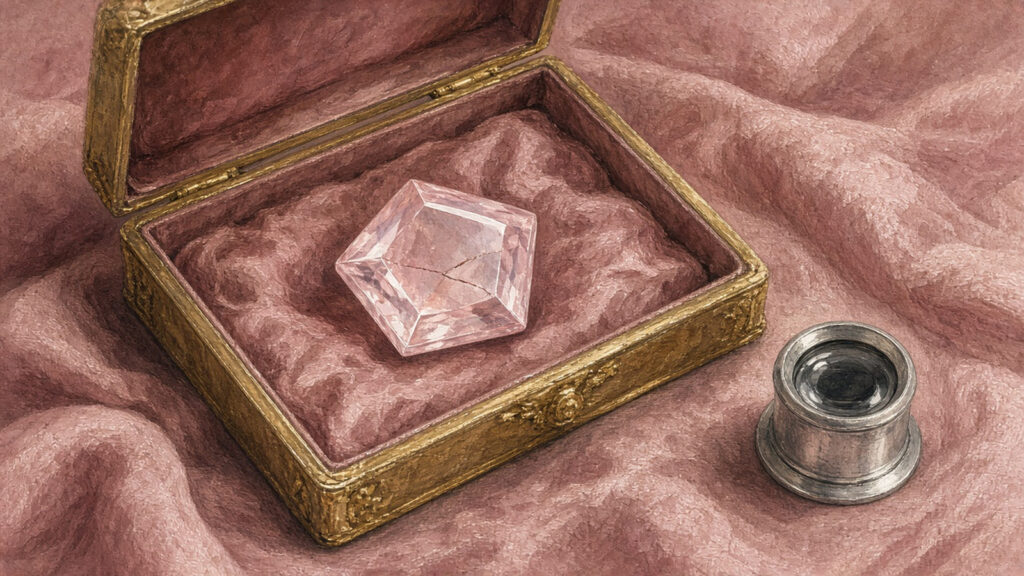
The Hortensia is a pink diamond, faintly tinged with orange-brown, that has belonged to the French crown since Louis XIV (Louvre). It first appears in the crown jewel inventory of 1691, was stolen when the royal Garde-Meuble was looted in September 1792, and was found again within weeks (Louvre). Sotheby’s gives its weight as 20.53 carats and says it is named for Hortense de Beauharnais, Queen of Holland and Napoleon’s stepdaughter (Sotheby’s). Here is what the record shows, and what the stone teaches anyone buying a coloured diamond today.
The Collector’s Summary
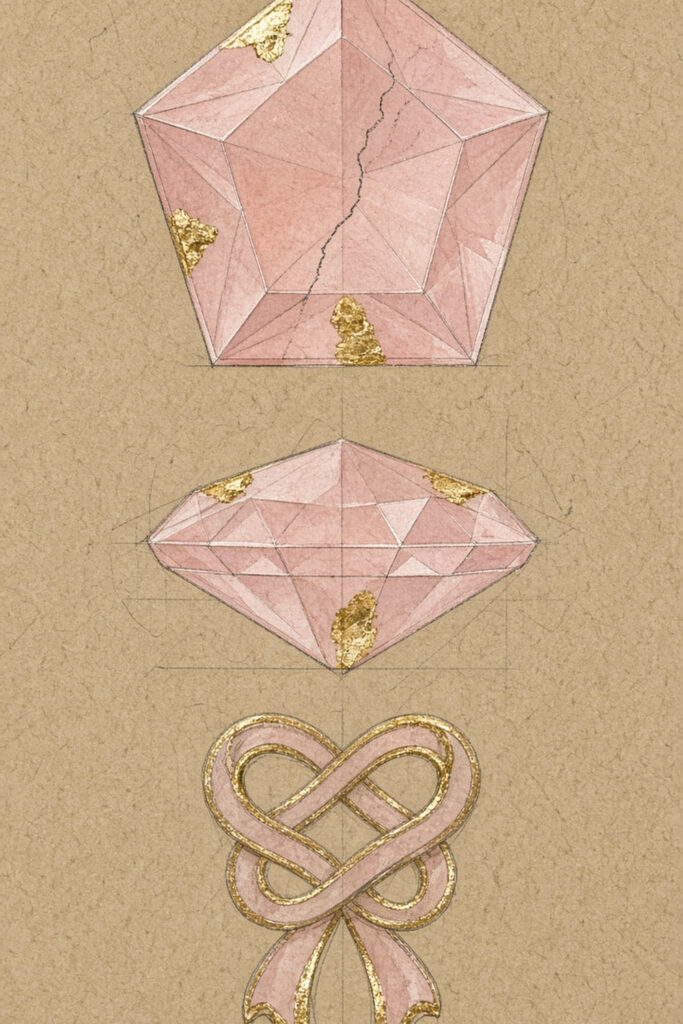
The Louvre describes the Hortensia as a five-sided pink diamond about 2.2 by 2 cm, acquired by Louis XIV and assigned to the museum in 1889 (Louvre). Lang Antiques notes a feather, a fine crack, running from the girdle toward the culet (Lang Antiques).
Jump to the timeline or what it teaches collectors.
Where did the Hortensia come from?
Nobody knows for certain. The Louvre says it may have been brought back by Jean Pitan the younger, the king’s jeweller and keeper of the royal gems, who made several trips to the Netherlands in the 1670s to buy diamonds (Louvre). In the 1691 inventory it was set in one of the king’s diamond parures (Louvre); Lang Antiques specifies a set of diamond buttonhole florets (Lang Antiques). We found no record of the mine or the cutter.
Why is it named after Hortense?
That is the mystery. Sotheby’s says the gem is named after Hortense de Beauharnais, daughter of the Empress Joséphine, stepdaughter of Napoleon and later Queen of Holland (Sotheby’s). Lang Antiques argues she had little or no access to the stone and never owned or wore it, and says the name was probably given sometime between 1806 and 1817 (Lang Antiques). Other references assume she wore it, so treat the reason for the name as unsettled.
How was it stolen, twice?
First in the Revolution. Between 11 and 17 September 1792 the Hôtel du Garde-Meuble, where the crown jewels were kept, was looted; the Louvre says the Hortensia was recovered the following month, when a man named François Dupeyron, condemned to death for theft, revealed its hiding place on his way to the scaffold (Louvre). Lang Antiques says it was found in an attic in the Halles district, with the Regent (Lang Antiques). It was stolen again in 1830, this time from the Ministry of the Navy, and quickly recovered (Lang Antiques).
How was it worn?
By an emperor and an empress. Under the First Empire it was mounted on the fastening of Napoleon’s epaulette braid, and in 1856 it became the centre of a diamond headband for Empress Eugénie (Lang Antiques). When the Third Republic sold most of the crown jewels in 1887, the Hortensia was kept back for its historic interest (Sotheby’s), and it was assigned to the Louvre in 1889 (Louvre).
Was it taken in the 2025 Louvre robbery?
No. On 19 October 2025 thieves took eight objects from the Louvre’s Apollo Gallery. The French Culture Ministry’s list, reported by France 24, names pieces from the sapphire set of Queen Marie-Amélie and Queen Hortense, Empress Marie-Louise’s emeralds, a reliquary brooch, and Empress Eugénie’s tiara and bodice-knot brooch; the Hortensia diamond is not on it (France 24). The Louvre’s online record, last updated in December 2025, lists the stone as not currently on display (Louvre).
The timeline
| Date | What happened | Source |
|---|---|---|
| 1691 | First recorded in the French crown jewel inventory | Louvre |
| September 1792 | Stolen in the looting of the Garde-Meuble | Louvre |
| October 1792 | Recovered after François Dupeyron reveals its hiding place | Louvre |
| First Empire | Mounted on Napoleon’s epaulette braid | Lang Antiques |
| 1830 | Stolen from the Ministry of the Navy and recovered | Lang Antiques |
| 1856 | Set in a headband for Empress Eugénie | Lang Antiques |
| 1887 | Excluded from the sale of the crown jewels | Sotheby’s |
| 1889 | Assigned to the Louvre | Louvre |
What it teaches collectors
Colour and clarity can pull in opposite directions. The Hortensia is famous for its rare colour, yet Langerman Diamonds notes that the 1791 inventory valued it at no more than 48,000 livres because of its crack (Langerman Diamonds). If you are offered a pink or orange-pink diamond, ask for a current laboratory report that states whether the colour is natural, and look closely at any feather that reaches the surface, which can affect durability as well as price. Use our authenticity checklist for anything you buy.
For the crown diamond stolen with it in 1792, read the Regent Diamond. For another stone from the French crown, see the Sancy Diamond, and for a jewel taken in the 2025 robbery, Empress Eugénie’s bow brooch. For the vertical hub, see the jewels worth knowing.
Questions people ask
How big is the Hortensia diamond?
20.53 carats, according to Sotheby’s. The Louvre gives its size as about 2.2 by 2 cm.
What colour is the Hortensia?
Pink, slightly tinged with orange-brown, according to the Louvre.
Was the Hortensia stolen?
Yes, twice: in the 1792 looting of the Garde-Meuble, when it was recovered the following month, and in 1830 from the Ministry of the Navy. It was not among the eight objects taken from the Louvre in October 2025.
Did Hortense de Beauharnais wear the Hortensia?
Sources disagree. The stone bears her name, but Lang Antiques says she never owned or wore it; we found no record that settles it.
Sources
- Musée du Louvre, collections record: Diamant rose à cinq pans dit Diamant Hortensia (MV 1016)
- Sotheby’s, Magnificent Jewels (Geneva, 2010), lot 550 note on the Hortense
- Lang Antiques, Antique Jewelry University: Hortensia Diamond
- Langerman Diamonds, Encyclopedia: Hortensia
- France 24, Thieves steal eight objects from Louvre in daring daytime heist (2025)
Finely Owned is independent and isn’t affiliated with the Musée du Louvre.