
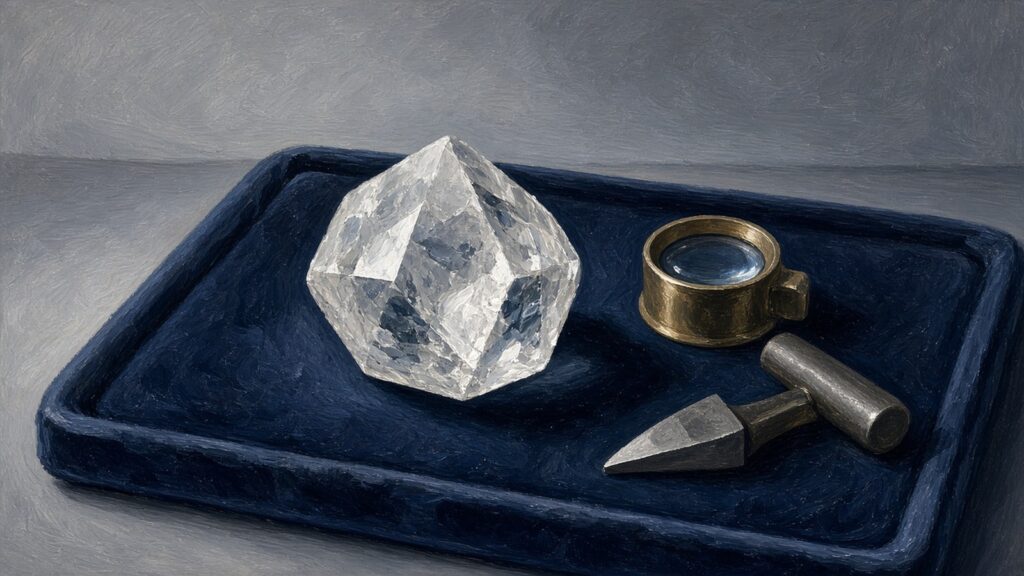
On January 25, 1905, a mine manager named Frederick Wells pulled a diamond out of the wall at the Premier Mine near Pretoria. It weighed 3,106 carats, the largest gem-quality rough diamond ever found. Two years later it was a birthday present for a king, and its two biggest pieces now sit in the British Crown Jewels (Royal Collection Trust, GIA).
The Collector’s Summary
The Cullinan Diamond was a 3,106-carat rough diamond found in South Africa in 1905 and named for the mine’s chairman, Thomas Cullinan. The Transvaal government bought it and gave it to King Edward VII in 1907. Joseph Asscher of Amsterdam cut it in 1908 into nine major stones and about a hundred smaller ones; the two largest are set in the Sovereign’s Sceptre and the Imperial State Crown.
Jump to the timeline or what it teaches collectors.
Who found the Cullinan Diamond?
Frederick Wells, the surface manager at the Premier Mine, spotted it in 1905 (Royal Collection Trust). The stone was named after Thomas Cullinan, who owned the mine. Uncut, it measured about 10.1 by 6.35 by 5.9 centimetres, and the Royal Collection Trust describes its colour as an exceptional blue-white (Royal Collection Trust). GIA published a full history and gemological study of its two largest stones in 2006 (GIA Gems & Gemology).
How did it become a gift to the king?
Louis Botha, prime minister of the Transvaal, proposed buying the diamond as a gift for the king. The Transvaal parliament approved the purchase in August 1907 for £150,000, and the stone was presented to Edward VII on November 9, 1907, his 66th birthday (Royal Collection Trust, GIA Gems & Gemology).
How was the Cullinan cut?
The king sent it to Joseph Asscher & Co. in Amsterdam. On February 10, 1908, Joseph Asscher struck the first blow to cleave it, and the steel blade broke; the second blow split the stone as planned. Over the following months the workshop polished nine major stones and about a hundred smaller ones, plus some unpolished fragments; the Trust counts 97 small brilliants (Royal Collection Trust, GIA Gems & Gemology). Cullinan I and II were presented to the king on November 21, 1908.
Where is the Cullinan Diamond now?
After Edward VII died in 1910, George V had Cullinan I, 530.2 carats, set in the Sovereign’s Sceptre with Cross, in a mount that lets it be removed, and Cullinan II, 317.4 carats, set in the Imperial State Crown. Both are part of the Crown Jewels in the Royal Collection (Royal Collection Trust).
What happened to the other Cullinan stones?
Asscher kept most of the smaller stones as payment for the cutting. Edward VII bought Cullinan VI and VIII for Queen Alexandra, and in 1910 the South African government bought the rest and gave them to Queen Mary. Cullinan III, a 94.4-carat pear, and IV, a 63.6-carat cushion, were set in Queen Mary’s 1911 coronation crown and often worn by her hooked together as a brooch. They passed to her granddaughter Elizabeth II in 1953, which is how they came to be called “Granny’s Chips” (Royal Collection Trust, GIA).
The timeline
| Date | What happened | Source |
|---|---|---|
| January 25, 1905 | Frederick Wells finds the 3,106-carat rough at the Premier Mine | Royal Collection Trust |
| August 1907 | The Transvaal parliament approves buying it for £150,000 | GIA |
| November 9, 1907 | It is presented to Edward VII on his 66th birthday | Royal Collection Trust |
| February 10, 1908 | Joseph Asscher cleaves it in Amsterdam | Royal Collection Trust |
| November 21, 1908 | Cullinan I and II are presented to the king | GIA |
| 1910 | South Africa gives the remaining Asscher stones to Queen Mary | Royal Collection Trust |
| After 1910 | George V has Cullinan I and II set in the Sceptre and the Imperial State Crown | Royal Collection Trust |
| 1953 | Elizabeth II inherits Queen Mary’s Cullinan stones | GIA |

What it teaches collectors
Big numbers are only half of a famous stone’s story. The Cullinan’s value to history comes from its paper trail: the mine record, the government vote, the cutter’s notes and the royal inventories. When you buy a diamond with any claimed history, ask for the grading report and the documents behind the story. Our authenticity checklist and our guide to reading a GIA report are good places to start.
For more famous stones, browse the jewelry worth knowing or read about the Hope Diamond.
Questions people ask
How big was the Cullinan Diamond?
The rough weighed 3,106 carats, about 621 grams, when it was found in South Africa in 1905. It is the largest gem-quality rough diamond on record. It was cut in 1908 into nine major stones, the largest of which, Cullinan I, weighs 530.2 carats.
Where is the Cullinan Diamond today?
Its two largest stones are in the British Crown Jewels. Cullinan I is set in the Sovereign’s Sceptre with Cross and Cullinan II is in the front of the Imperial State Crown. Several smaller Cullinan stones are in brooches and other royal jewels.
How much is the Cullinan Diamond worth?
There is no public valuation. The Transvaal government paid £150,000 for the rough in 1907, but the cut stones are part of the Royal Collection and have never been offered for sale, so any modern figure you see is an estimate, not a price.
Who cut the Cullinan Diamond?
Joseph Asscher & Co. of Amsterdam. Joseph Asscher cleaved the stone on February 10, 1908. The first blow broke the blade, and the second split the diamond. The firm then cut nine major stones and about a hundred smaller ones over the following months.
For the other great diamond in the Crown Jewels, read The Koh-i-Noor Diamond
For another stone from the Cullinan mine, read The Blue Moon of Josephine
Sources
- Royal Collection Trust, The Cullinan Diamond
- Scarratt and Shor, The Cullinan Diamond Centennial, Gems & Gemology, Summer 2006 (GIA)
- GIA, Historical reading list: the Cullinan Diamond
- GIA 4Cs, Famous diamonds: the legacy of Granny’s Chips
Finely Owned is independent and isn’t affiliated with the Royal Collection Trust or Asscher.