

Mohandas Gandhi owned almost nothing, and he kept track of time obsessively. He rose at 4 a.m., wrote dozens of letters a day, and apologized if he was a minute late. He called his watch “Lady Watch” and told correspondents she was reminding him it was time for his walk (Lapham’s Quarterly). For about twenty years, one of those watches was a plain silver Zenith with an alarm and a dial that glowed at night. It was stolen from him at a railway station in 1947 and returned by a remorseful thief, given to the grandniece in whose arms he died, and sold in New York in 2009 for more than $2 million, against the wishes of the Indian government, over the protests of his great-grandson, and after its own seller tried to stop the sale. This is the story of Gandhi’s Zenith pocket watch through its owners, and what it teaches anyone who inherits a watch. For more watch stories, start with The Watches Worth Knowing.
The Collector’s Summary
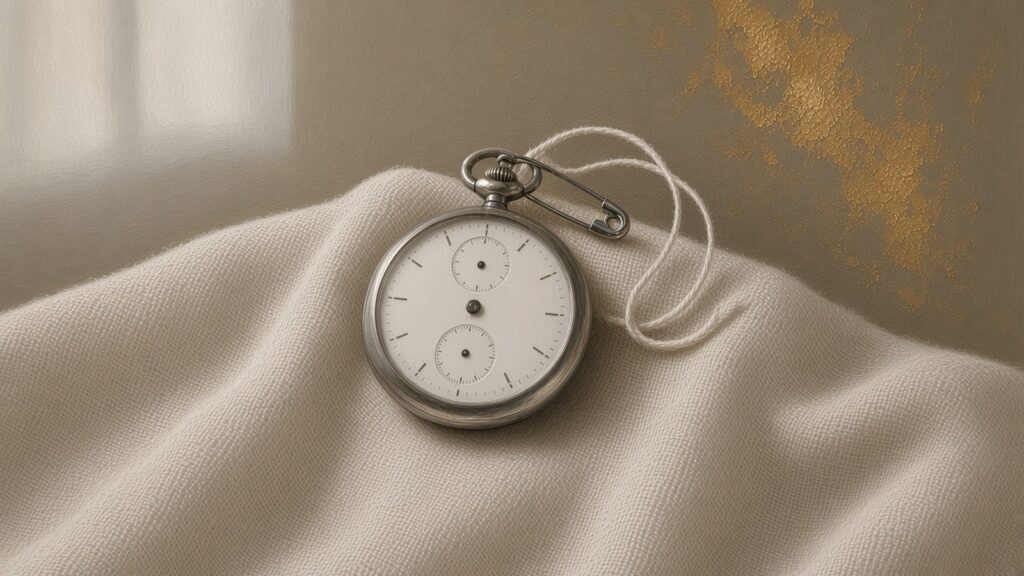
Gandhi’s Zenith is a sterling silver keyless pocket watch with an alarm, made around 1910 (movement No. 421357, case No. 49529). It was a gift to Gandhi, who used it for about twenty years and gave it in the 1940s to his grandniece and assistant Abha Gandhi. At Antiquorum in New York on 5 March 2009 it sold with his spectacles, sandals, bowl and plate for $1.8 million at the hammer, $2,096,000 with the buyer’s premium, to the Indian businessman Vijay Mallya.
Read the timeline of owners and what it teaches anyone who inherits a watch.
Who gave Gandhi the Zenith watch?
The sources disagree on the giver, and it is worth saying so. Zenith’s own heritage page says Gandhi was given the watch by his friend Jawaharlal Nehru, India’s first prime minister (Zenith). A footnote in The Collected Works of Mahatma Gandhi, quoted by The Times of India, calls it “a present from Indira Nehru,” Nehru’s daughter, which Gandhi “had been using for about 20 years.” Lapham’s Quarterly also says Indira gave it to him when she was a girl.
What everyone agrees on is why he liked it. It was practical. In his own description it had “a radium disc” that let him read it in the dark and “a contrivance for alarm,” and it cost “over Rs 40” (The Times of India). Zenith says the alarm signaled his prayer times (Zenith).
What is Gandhi’s Zenith pocket watch like?
It is an ordinary good watch of its day, not a luxury piece. The Antiquorum catalogue describes a sterling silver keyless pocket watch made around 1910, 49 mm across and 16 mm thick, in a three-part “bassine” case with an engine-turned back and a hinged silver inner cover. The white enamel dial has luminous Arabic numerals, a small seconds dial at 6 and an alarm dial at 12, with blued-steel skeleton hands. Inside is a 15-jewel gilt-brass lever movement. The dial and movement are signed by Zenith, and the case and movement carry the numbers 49529 and 421357.
Gandhi did not only use one watch. His other famous watch, a cheap Ingersoll he wore pinned to his dhoti with a safety pin and a loop of khadi string, is displayed at the National Gandhi Museum in New Delhi (Lapham’s Quarterly). When a friend sent him a gilded watch after the Zenith was stolen, he scolded him that it was “like caparisoning a donkey in gold” and that it had no alarm and no glowing dial (Lapham’s Quarterly). He valued what the Zenith did, not what it was worth.
How was Gandhi’s watch stolen, and how did he get it back?
It was taken at Kanpur station on 25 May 1947, while he was traveling by train. In a note dated 28 May he described it in detail, ending simply, “It was a gift to me” (The Times of India). He published an appeal for its return in his newspaper, Harijan (Lapham’s Quarterly).
The thief, by these accounts a souvenir hunter, felt remorse. According to Zenith and to The Times of India, he came to see Gandhi in New Delhi about six months later, returned the watch and asked his forgiveness (Zenith).
Who inherited Gandhi’s Zenith watch?
In the 1940s Gandhi gave the watch to Abha Gandhi, his grandniece by marriage and his assistant for six years. She was beside him when he was shot on 30 January 1948, and he died in her arms. The auction catalogue says that Abha left the watch, with a bowl and a plate he had also given her, to her daughter, who wrote the letter of authenticity for the sale (Antiquorum). Lapham’s Quarterly adds a detail from that last evening: Abha and Manu, his grandnieces, were responsible for reminding him of the time, and held back because the meeting he was in mattered so much. He was late for prayers, and minutes later he was dead.
From the family the watch reached the collecting world. Gandhi’s great-grandson, Tushar Gandhi, said that a German collector had acquired the rights to the watch from Abha in the 1990s, and he condemned the trade in his great-grandfather’s things (The Telegraph). By 2009 it belonged to James Otis, a Los Angeles filmmaker and peace activist, who had spent more than a decade assembling the belongings that best showed Gandhi’s simple life (The New York Times). Otis said he had obtained them from members of the family or at other auctions.
What happened at the 2009 Gandhi auction?
It became a national argument in India. Antiquorum offered the watch as lot 364 at its New York sale on 5 March 2009, with Gandhi’s spectacles, a pair of sandals, a bowl and a plate, at an estimate of $20,000 to $30,000 (Antiquorum). The Navjivan Trust, which Gandhi founded, argued that under his will his belongings should go to the trust, and the Delhi High Court issued an injunction against the sale (Rediff / PTI, India Today).
Otis himself had second thoughts. While his lawyer tried to stop the sale, he offered to withdraw the items if the Indian government agreed to spend more on its poorest citizens; India rejected his conditions (The Guardian, BBC News). The auction went ahead. In about four minutes bids rose from $10,000 to $1.8 million, from the floor, the phone and the internet (The Guardian). The second-highest bid, $1.75 million, came online from Britain (India Today). The winner was Tony Bedi, bidding for Vijay Mallya, the Indian liquor and airline businessman, who said he wanted the things returned to India for public display (India Today). With the buyer’s fee of $296,000 the total came to $2,096,000 (The New York Times, WatchTime).
There was an irony, and Lapham’s Quarterly pointed it out: a fortune made from alcohol had bought back the belongings of a man who campaigned all his life against drink. Otis later apologized in Delhi for the “unintentional hurt” and said the proceeds would go to groups promoting Gandhian values (BBC News).
Where is Gandhi’s Zenith watch now?
Mallya said soon after the sale that the items had been paid for and delivered to him, and that he intended to bring them to India for display (The New York Times). Their journey stalled over import duty: India’s rules waived duty only on items bound for a public museum or institution, and in April 2009 the watch was, in Otis’s words, “somewhere in between” (Rediff / PTI, BBC News). We have not found a museum record or a later report that confirms where the watch is shown today, so we won’t guess. A different Zenith alarm pocket watch of the same model, owned by Zenith, has toured Indian stores in exhibitions (The Times of India).
Gandhi’s Zenith: a timeline of owners
| Year | Owner or event | Source |
|---|---|---|
| c. 1910 | The watch is made by Zenith in Le Locle, Switzerland | Antiquorum |
| c. 1927 | Given to Gandhi, by Nehru (Zenith) or by Indira Nehru (collected works footnote) | The Times of India |
| 1947 | Stolen at Kanpur station on 25 May; returned by the thief about six months later | Lapham’s Quarterly |
| 1940s | Given by Gandhi to his grandniece and assistant, Abha Gandhi | Antiquorum |
| 1948 | Gandhi is assassinated on 30 January, in Abha’s arms | Lapham’s Quarterly |
| 1990s | A German collector acquires rights to the watch from Abha, according to Tushar Gandhi | The Telegraph |
| 2009 | Sold at Antiquorum, New York, 5 March, to Vijay Mallya for $2,096,000 with fees | Antiquorum |
| 2009 | Import-duty dispute delays its return to India | BBC News |
The c. 1927 date is counted back from the “about 20 years” of use recorded in 1947, so treat it as approximate.
What Gandhi’s watch teaches anyone who inherits a watch
Most of us will never inherit a watch that sells for $2 million. Plenty of us will inherit a father’s or grandmother’s pocket watch with a story attached, and the arguments over this one show what to do while the story is still fresh.
- Write down who gave it, and admit what you don’t know. Even Gandhi’s watch has two versions of who gave it. Record the giver, the date and how you know, and note where family memory and documents differ. Our authenticity checklist lists what to keep.
- Copy the numbers. The catalogue identified this watch by its movement and case numbers, 421357 and 49529 (Antiquorum). Photograph the dial, the case back and the inside of the case lid, and write the numbers down. Our guide to serial and reference numbers explains how makers use them.
- Keep the letters. The lot sold with letters of authenticity from the family (Antiquorum). For your own watch, a short signed note from the person who knew its history, with the boxes, receipts and service papers, is worth keeping together. See why box and papers matter.
- Settle who it belongs to before anyone sells it. Gandhi’s will, the claims of a trust founded by him, and an injunction from a court all collided at this sale (Rediff / PTI). Name the watch and the person in a will or a letter of wishes, and make sure siblings know.
- Be careful with an old glowing dial. The U.S. Environmental Protection Agency notes that watches and clocks from the early 1900s that glow without a battery may contain radium (EPA). Gandhi’s had a “radium disc.” Don’t scrape or open the dial yourself; tell your watchmaker it may be radium before any work.
- Service it for use, not for resale. A hundred-year-old alarm watch needs a watchmaker who works on vintage pieces, and original parts are worth keeping even when they are replaced. Our servicing guide covers what a service involves and what to ask for back.
For a different kind of inheritance story, read how Hans Wilsdorf left Rolex to a foundation, or how Marie Antoinette’s Breguet was finished decades after the queen died.
Questions people ask
What watch did Gandhi wear?
Gandhi used two well-known watches. One was a silver Zenith alarm pocket watch made around 1910, which he used for about twenty years and which sold at auction in 2009. The other was a cheap Ingersoll pocket watch that he wore pinned to his dhoti, now displayed at the National Gandhi Museum in New Delhi.
Who gave Gandhi the Zenith watch?
Accounts differ. Zenith says it was a gift from Jawaharlal Nehru. A footnote in The Collected Works of Mahatma Gandhi says it was a present from Indira Nehru, Nehru’s daughter and later Prime Minister Indira Gandhi.
How much did Gandhi’s pocket watch sell for?
It sold at Antiquorum in New York on 5 March 2009, as lot 364 with Gandhi’s spectacles, sandals, bowl and plate, for $1.8 million at the hammer and $2,096,000 including the buyer’s premium. The pre-sale estimate was $20,000 to $30,000.
Who bought Gandhi’s watch?
Tony Bedi placed the winning bid on behalf of Vijay Mallya, the Indian businessman, who said he would return the items to India for public display.
Was Gandhi’s watch stolen?
Yes, once. It was stolen at Kanpur railway station on 25 May 1947. Gandhi appealed for its return, and the thief returned it about six months later and asked for his forgiveness.
Another famous watch that went missing: Buzz Aldrin’s Omega Speedmaster, lost in a shipment to the Smithsonian around 1971.
For another plain watch owned by a world figure, read Albert Einstein’s Longines
For another famous owner’s pocket watch, read Abraham Lincoln’s Pocket Watch
Sources
- Antiquorum, “Important Collectors’ Wristwatches, Pocket Watches & Clocks,” New York, 5 March 2009, lot 364
- The New York Times, “Despite Outcry, Gandhi Items Sell for $1.8 Million” (6 March 2009)
- The New York Times City Room, “Deal Clears Path to India for Gandhi Items” (24 March 2009)
- The Guardian, “Gandhi’s possessions saved by $1.8m bid – or not” (6 March 2009)
- India Today, “Mallya buys Gandhi memorabilia” (5 March 2009)
- BBC News, “US man sorry over Gandhi auction” (2009)
- Rediff / PTI, “Legal wrangles may delay arrival of Gandhi’s relic” (15 March 2009)
- The Telegraph, “Gandhi heirs condemn auction of his belongings” (2009)
- Nina Martyris, “The Most Punctual Man in India,” Lapham’s Quarterly (2 December 2014)
- Zenith, “Gandhi” heritage page
- The Times of India, “Bapu’s legendary Swiss pocket watch on display” (2016)
- WatchTime, “Gandhi Items Top $2 million at Auction” (2009)
- U.S. Environmental Protection Agency, “Radioactivity in Antiques”
Finely Owned is independent and isn’t affiliated with Zenith, LVMH, Antiquorum or the National Gandhi Museum.