

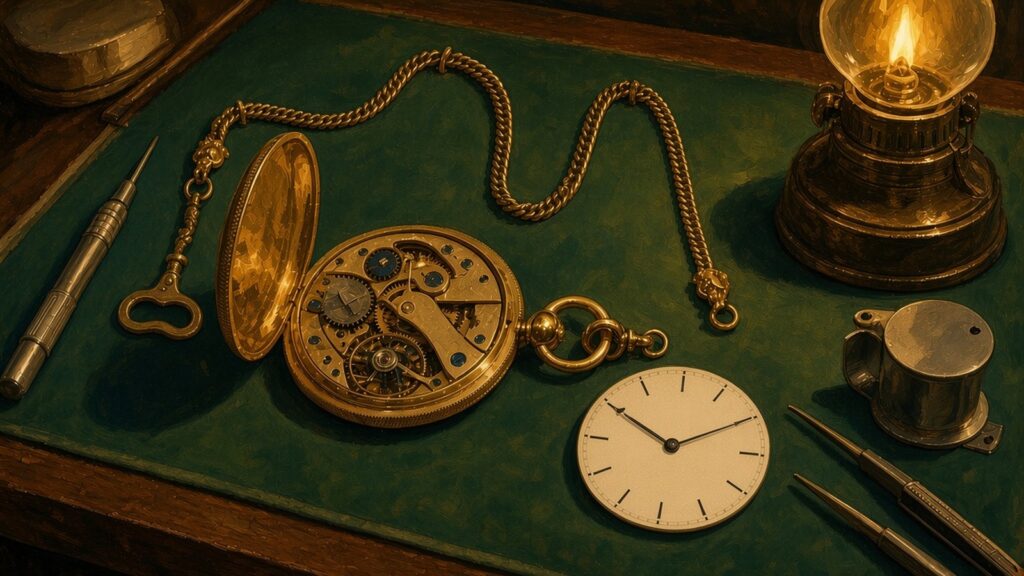
Abraham Lincoln bought an English gold pocket watch in the 1850s from George Chatterton, a jeweler in Springfield, Illinois (Smithsonian). On 10 March 2009, the Smithsonian’s National Museum of American History opened it and found a message engraved inside by a Washington watchmaker on the day after the Civil War began (Smithsonian, The New York Times). Lincoln never knew it was there. Here is what the record shows about Abraham Lincoln’s pocket watch, and what it teaches collectors.
The Collector’s Summary
The watch has a movement made in Liverpool, England, in an 18-karat gold case made by an unidentified American shop. The Smithsonian calls the movement one of the best grades made in England, able to keep time within a few seconds a day in good order (Smithsonian). It has been in the museum’s collection since 1958 (Smithsonian).
Jump to the timeline or what it teaches collectors.
What watch did Abraham Lincoln carry?
A fine English gold pocket watch. The museum says the movement and the case were made separately, as was typical at the time: the movement in Liverpool, where a large watch industry worked at every grade, and the 18-karat case in America (Smithsonian). The Smithsonian notes that Lincoln was not considered outwardly vain, but that the gold watch was a conspicuous sign of his success as a lawyer (Smithsonian). Men of his time carried their watches in a pocket; the wristwatch only became common for men after the First World War (Smithsonian).
What was the secret message inside Lincoln’s watch?
A watchmaker’s note about Fort Sumter. In April 1861 Jonathan Dillon was repairing the watch at M. W. Galt and Co. on Pennsylvania Avenue in Washington when the shop’s owner announced that the war had begun (Smithsonian). Dillon unscrewed the dial and engraved the brass beneath. The museum’s transcription reads: “Jonathan Dillon April 13-1861 Fort Sumpter [sic] was attacked by the rebels on the above date J Dillon April 13-1861 Washington thank God we have a government Jonth Dillon” (Smithsonian).
Did the message say what Dillon remembered?
No. In an interview with The New York Times published on 30 April 1906, Dillon, then 84, recalled writing: “The first gun is fired. Slavery is dead. Thank God we have a President who at least will try” (Smithsonian, Smithsonian). The words inside the watch are plainer. The museum also found other markings: a second watchmaker, L. E. Gross, signed it in 1864, and at some point someone scratched “Jeff Davis” inside, either as a joke or as a statement of Confederate support (Smithsonian).
How was the message found?
Through a family story. On Lincoln’s 200th birthday, 12 February 2009, Doug Stiles, a lawyer from Waukegan, Illinois, and Dillon’s great-great-grandson, phoned curator Harry Rubenstein about the tale (Smithsonian Magazine). Stiles had found the 1906 Times article (The New York Times). Because the museum held the right watch, it agreed to open it (Smithsonian). On 10 March 2009 the museum volunteer and master watchmaker George Thomas removed the hands and dial in front of staff, reporters and the Dillon family, and Stiles read the inscription aloud (Smithsonian).
Is there more than one Lincoln watch?
Yes. A separate Lincoln pocket watch, with chain and fob, is in the Kentucky Historical Society’s collection. Robert Todd Lincoln inherited it and gave it to his cousin Benjamin Hardin Helm Jr., who gave it to the Lincoln scholar William H. Townsend in 1943 (Kentucky General Assembly). The Townsend family believed Lincoln carried it on the night he was shot, but the society’s own note says there is no evidence for that (Kentucky General Assembly). We found no record of either watch ever being offered for sale.
The timeline
| Date | What happened | Source |
|---|---|---|
| 1850s | Lincoln buys the gold watch from George Chatterton in Springfield | Smithsonian |
| 13 April 1861 | Jonathan Dillon engraves his note under the dial at M. W. Galt and Co. | Smithsonian |
| 1864 | Watchmaker L. E. Gross signs the movement | Smithsonian |
| 30 April 1906 | Dillon, 84, describes the engraving to The New York Times | Smithsonian |
| 1958 | Lincoln Isham, Lincoln’s great-grandson, gives the watch to the Smithsonian | Smithsonian |
| 12 February 2009 | Doug Stiles calls the museum about the family story | Smithsonian Magazine |
| 10 March 2009 | The museum opens the watch and finds the message | The New York Times |
What it teaches collectors
Look under the dial. The Smithsonian notes that 18th- and 19th-century watchmakers often recorded their work inside a watch, where usually only another watchmaker would see it (Smithsonian). Service marks like these can date repairs and trace a watch’s life, which is why a good watchmaker photographs the movement before and after work. The Dillon story also shows how memory drifts: the family account was true in substance, but the words were different. Treat any “it was engraved inside” claim as a story until someone opens the case. Use our authenticity checklist before you buy any watch with a famous name attached.
For another pocket watch with a famous owner, read Gandhi’s Zenith pocket watch. For a statesman’s repeater, see Winston Churchill’s Breguet, and for a president’s watch from the next century, JFK’s Omega. For the vertical hub, see the watches worth knowing.
Questions people ask
What was written inside Abraham Lincoln’s watch?
“Jonathan Dillon April 13-1861 Fort Sumpter was attacked by the rebels on the above date J Dillon April 13-1861 Washington thank God we have a government Jonth Dillon.” A watchmaker engraved it under the dial in 1861.
Where is Abraham Lincoln’s pocket watch now?
At the Smithsonian’s National Museum of American History in Washington. Lincoln’s great-grandson Lincoln Isham gave it to the museum in 1958.
Did Lincoln know about the message in his watch?
No. The Smithsonian says Lincoln never knew of the message, which stayed hidden behind the dial until 2009.
What kind of watch did Lincoln have?
An English gold pocket watch with a Liverpool-made movement and an 18-karat American case, bought in the 1850s from George Chatterton of Springfield, Illinois.
Sources
- Smithsonian National Museum of American History, Abraham Lincoln’s Watch, around 1858
- Smithsonian, Smithsonian Uncovers Secret Message Inside Abraham Lincoln’s Watch (2009)
- National Museum of American History, A secret message inside Lincoln’s watch? (2009)
- National Museum of American History, Etched in time: Douglas Stiles and Abraham Lincoln
- The New York Times, Timeless Lincoln Memento Is Revealed (2009)
- Smithsonian Magazine, Secret Message Found in Lincoln’s Watch
- Kentucky General Assembly, Moments in Kentucky Legislative History: Abraham Lincoln’s pocket watch
Finely Owned is independent and isn’t affiliated with the Smithsonian Institution, the Kentucky Historical Society or the Lincoln or Dillon families.