

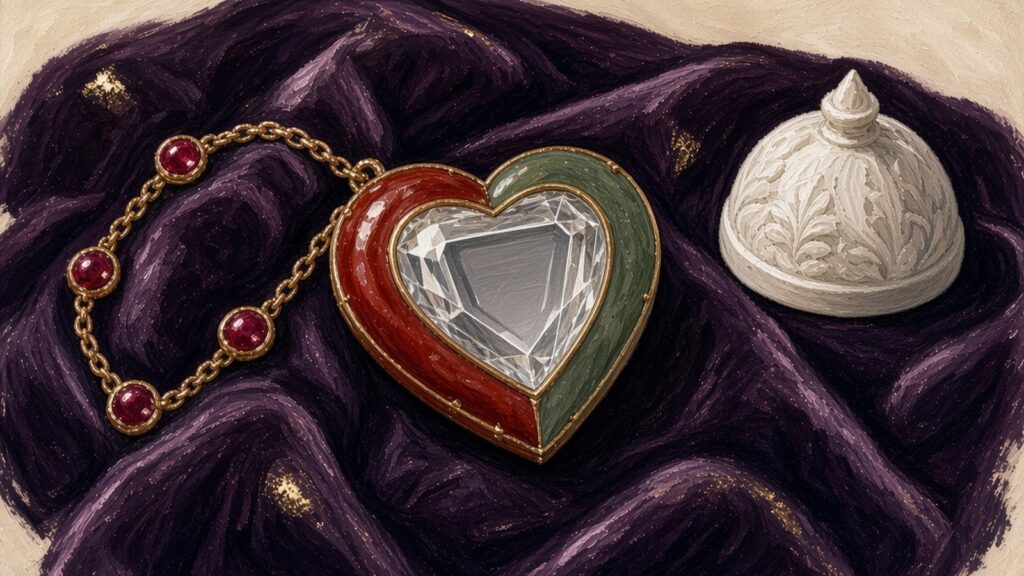
The “Taj Mahal” is a heart-shaped, table-cut Indian diamond inscribed with the name Nur Jahan and the Islamic date 1037, or 1627–28, hung from a gold, ruby and diamond chain made by Cartier (Christie’s). Richard Burton gave it to Elizabeth Taylor for her 40th birthday in 1972, and Christie’s sold it in her 2011 collection sale for $8,818,500 (Christie’s). Here is what the record shows, what it does not, and what the jewel teaches collectors.
The Collector’s Summary
Christie’s catalogued the jewel as an Indian diamond and jade pendant necklace with a later Cartier neckchain, estimated at $300,000–500,000, and it sold on 13 December 2011 for $8,818,500, a record then for any Indian jewel at auction (Christie’s, Christie’s). The sale was later cancelled at the buyer’s request, and the cancellation became the subject of a lawsuit by Taylor’s trust (National Jeweler).
Jump to the timeline or what it teaches collectors.
What does the inscription on the diamond say?
Three things. Christie’s gives the literal translation of the Persian inscription as “Nur Jahan Baygum-e Padshah; 23; 1037”: Nur Jahan, a lady of the Padshah, the 23rd regnal year of the emperor Jahangir, and the Islamic year 1037, equivalent to 1627–28 (Christie’s). Christie’s notes that it is not known whether Nur Jahan ever owned or wore the jewel.
Why is it called the Taj Mahal?
Because of the story attached to it. Christie’s wrote that the jewel is believed to have passed from Jahangir to his son, the emperor Shah Jahan, who gave it to his wife Mumtaz Mahal, in whose memory he built the Taj Mahal (Christie’s). Note the wording: “believed to have passed.” That chain of ownership is a tradition, not a documented line of receipts.
How did Elizabeth Taylor come to own it?
As a birthday gift. Christie’s says Richard Burton gave the Taj Mahal to Taylor for her 40th birthday (Christie’s), which was in 1972. Christie’s dates the Cartier neckchain to circa 1972 and says it was made in the style of the silk cord the pendant would originally have hung from (Christie’s).
What happened at the 2011 auction?
It sold far above estimate. In the first evening of “The Collection of Elizabeth Taylor” on 13 December 2011, the Taj Mahal made $8,818,500 against a $300,000–500,000 estimate, which Christie’s called a record for any Indian jewel at auction. The same night, the Elizabeth Taylor Diamond also made $8,818,500 (Christie’s).
Why was the sale later cancelled?
National Jeweler reported that months after the auction the buyer asked Christie’s to cancel the sale because he doubted the stone had belonged to Shah Jahan, and that Christie’s rescinded it. Taylor’s trust sued Christie’s, arguing the catalogue only guaranteed an “Indian diamond,” not its imperial history (National Jeweler). We found no public record of a later sale.
The timeline
| Date | What happened | Source |
|---|---|---|
| 1037 AH (1627–28) | Date inscribed on the diamond, with the name Nur Jahan | Christie’s |
| 1972 | Richard Burton gives the pendant to Taylor for her 40th birthday; Cartier neckchain circa 1972 | Christie’s |
| 13 December 2011 | Sold at Christie’s New York for $8,818,500 | Christie’s |
| After the sale | Buyer asks Christie’s to cancel; Christie’s rescinds the sale | National Jeweler |
| Later | Taylor’s trust sues Christie’s over the cancellation | National Jeweler |

What it teaches collectors
Separate what is guaranteed from what is told. Christie’s guaranteed an Indian diamond with a dated inscription and a Cartier chain; the imperial story was background, and the buyer’s doubts about it unwound an $8.8 million sale. When you buy a piece with a story, ask which parts the seller will put in writing, and use our authenticity checklist.
For more of Taylor’s jewels, read the Krupp Diamond, the Taylor-Burton Diamond and La Peregrina. For the vertical hub, see the jewelry guide.
Questions people ask
What is the Taj Mahal diamond?
A heart-shaped, table-cut Indian diamond inscribed with the name Nur Jahan and the date 1037 (1627–28), set as a pendant on a Cartier gold, ruby and diamond chain. It belonged to Elizabeth Taylor.
Who gave Elizabeth Taylor the Taj Mahal diamond?
Richard Burton, for her 40th birthday in 1972, according to Christie’s.
How much did the Taj Mahal diamond sell for?
$8,818,500 at Christie’s New York on 13 December 2011, against a $300,000–500,000 estimate. National Jeweler later reported that the sale was cancelled at the buyer’s request.
Did Mumtaz Mahal own the diamond?
Christie’s said the jewel is believed to have passed to Shah Jahan, who gave it to Mumtaz Mahal. That is a tradition rather than a documented record, and the buyer later disputed it.
Sources
- Christie’s, The Taj Mahal, lot details
- Christie’s, The Legendary Jewels post-sale release, 2011
- National Jeweler, ‘Taj Mahal’ pendant back at the center of dispute
Finely Owned is independent and isn’t affiliated with Cartier, Christie’s or the Elizabeth Taylor estate.