
The appraisal starts at the handle

Watch someone who knows bags pick one up. They don’t start with the logo. They hold it by the handle, feel the weight, turn it to see how the corners have worn and whether the shape still stands up on its own. Then they open it.
What they’re reading is everything the bag has been through. A handle darkened evenly from use, corners that are rubbed but not split, stitching that still sits tight: those are the marks of a bag that was carried and cared for. A trained eye can tell a lot about the previous owner, and about the bag’s future, in a minute or two.
This guide to pre-owned designer handbags is where Finely Owned does that slowly. We don’t review bags by the season. We appraise them the way a collector would, with the history of the design in hand and a clear list of what to check before you keep one.
Bags that began as something else

Many of the bags people now call classics started out as tools.
The Kelly. Hermès began as a harness maker in Paris in 1837, and its most famous bag comes from that world. In the 1930s Robert Dumas drew a smaller version of a rider’s strapped saddlebag for women. In 1956, newly Princess of Monaco, Grace Kelly was photographed holding hers in front of her, and the public began calling it by her name. We tell that story in full in Grace Kelly and the Hermès Kelly, from the saddler’s original to the battered bag the Victoria and Albert Museum put on display.
The Speedy. Louis Vuitton started as a trunk maker in 1854. Sotheby’s tells how the house launched the Speedy in 1930, first called the “Express,” as a soft bag for a faster age of travel. It came only in a 30 cm size at first; the 35 and 40 followed, and the smaller 25 is said to have come after Audrey Hepburn asked the house for a size to suit her. Sotheby’s also points out a detail worth knowing: the bag is cut from one continuous piece of canvas, so the monogram on one side runs upside down. That is how it’s made, not a flaw.
The 2.55. Gabrielle Chanel created her quilted bag with a chain strap in February 1955 and named it after the date, according to the house. It was made to free the hands. Chanel quotes her saying she was “tired of carrying my bags by hand and losing them,” and notes that the bag is still sewn like a garment, from the inside out. WWD records that the house brought out the 2.55 Reissue for the bag’s fiftieth anniversary in February 2005.
The Birkin. The youngest of these is the Birkin, from 1984. Jane Birkin told Vogue how it began with a conversation with Hermès chief executive Jean-Louis Dumas on a flight, and a sketch on an airline sick bag.
What these bags share is a reason to exist beyond looking good, and that is usually what keeps a bag in demand long after its season.
How we appraise

Every handbag story on Finely Owned follows the same path, so you always know where you are.
- The appraisal. What a trained eye notices first, and what the bag says about the person carrying it.
- Where it came from. The year, the house and the versions that followed, checked against the house’s own history and reputable sources.
- Famous carriers and moments. Only the ones we can document, with links.
- What owners say. Real accounts from collectors, paraphrased and credited to where they were posted.
- The buying guide. Leather, hardware, stamps, condition, what comes with it and what to check before you keep a pre-owned bag.
- Why it costs what it does. The short version, in one line.
We don’t print prices in our stories. Resale prices move quickly, and a figure in an article goes stale before the leather does. Where a number matters, it carries the date it was true.
Reading a pre-owned bag
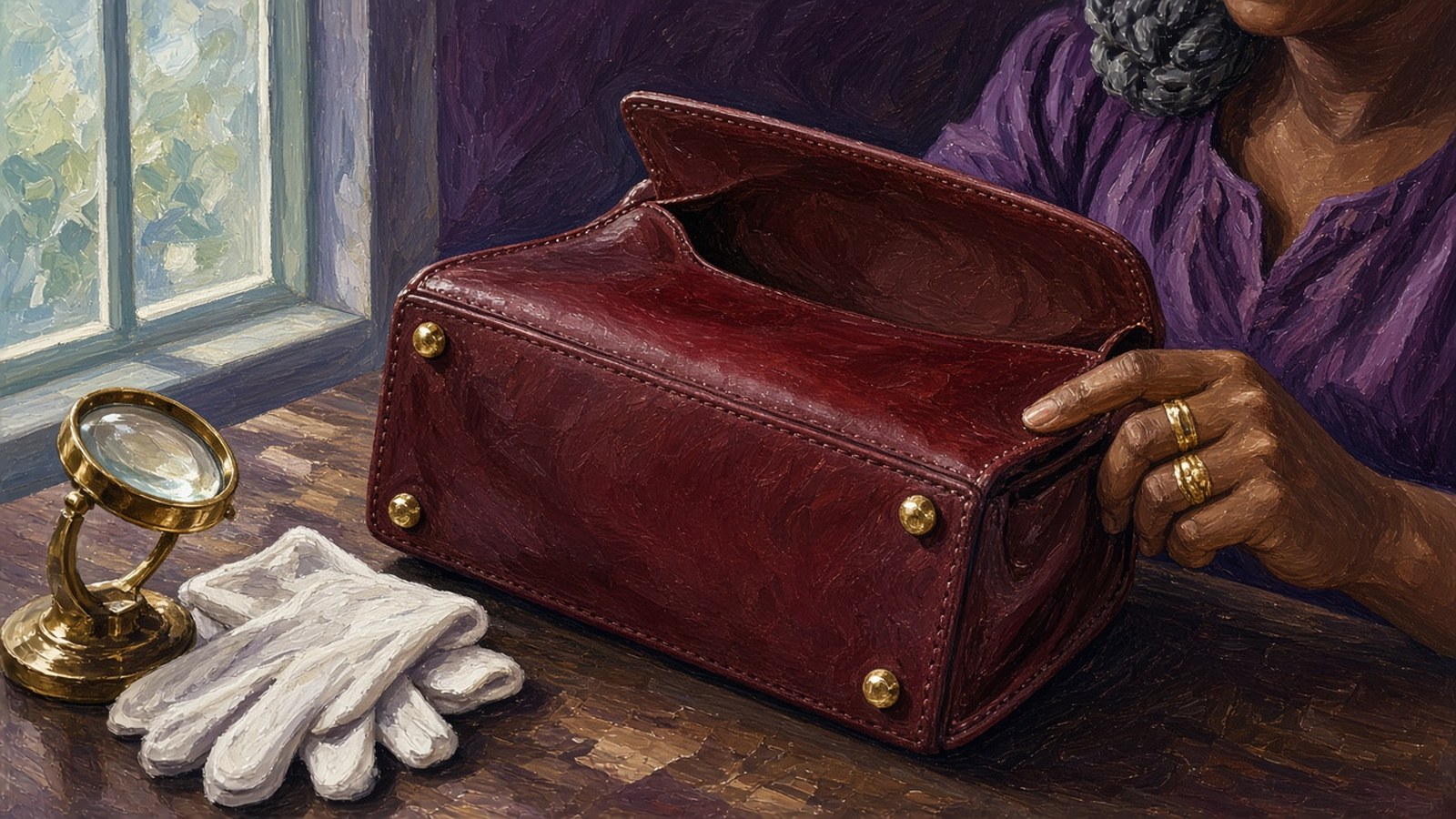
The best guidance we’ve found comes from the people who check bags before they go under the hammer. Christie’s head of handbags, Rachel Koffsky Parker, set out the auction house’s approach to Hermès in detail, and much of it is a good habit for any bag. Her list includes:
- The leather. Each leather has its own texture, weight and scent, and it should fit the bag’s era. Christie’s notes that Hermès Evercolor leather only arrived in 2013, so it shouldn’t appear on an older bag.
- The stitching. The saddle stitch needs two needles passing through the same seam and can’t be done by machine. It should look hand-done.
- The hardware. Zips should move smoothly, locks should turn easily and the metal feet should be hammered in, not glued. Engravings should be crisp.
- The stamps. Logo stamps should be clean and evenly spaced. The small date stamp, where there is one, should be subtle and should match the era of the bag. Not every genuine bag has one.
- The packaging and papers. Boxes and dust bags help, but not every pre-owned bag still has them. Hermès doesn’t issue authenticity cards, and Christie’s says any Hermès bag sold with one is fake.
Christie’s closing advice applies to every house: buy from a seller you trust, read the terms, and be wary of a price that seems too good to be true.
Who sells pre-owned bags
The bags we feature are pre-owned and offered by independent resellers that authenticate what they sell. In June 2025 Rebag announced it was bringing nearly 30,000 pre-loved pieces to Amazon Luxury Stores, from houses including Hermès and Louis Vuitton. What Goes Around Comes Around also runs a pre-owned storefront there.
These resellers aren’t affiliated with the houses whose bags they sell, so the reseller’s own authentication is what you are relying on. That is why we always name the seller and suggest you read how it authenticates before you buy.
Stories in this guide

The first story in this guide is ready to read.
Grace Kelly and the Hermès Kelly: How a Princess Renamed a Handbag
A saddler’s bag drawn in the 1930s, a photograph taken in 1956, and a scuffed original that ended up in a museum case. Then the practical part: how a Kelly is made, the difference between Sellier and Retourné, and what to check before you keep a pre-loved one.
These are next, and we’ll link each one here as it’s published:
- The Hermès Birkin: a conversation on a flight, a sketch on a sick bag, and why the Birkin and the Kelly are so often confused.
- The Chanel 2.55 and the Classic Flap: the bag named after a date, and how to tell the original lock from the interlocking CC.
- The Louis Vuitton Speedy: a 1930 travel bag that became an everyday one, and what its canvas tells you.
- Reading a Hermès date stamp: what the small blind stamp means, and why not every bag has one.
The houses behind these bags have their own pages in The Maisons. For pieces worn rather than carried, see our jewelry guide and our watches guide, and for the dressing table, The Vanity.
Questions we’re often asked
What’s the difference between a Kelly and a Birkin?
They are often confused, and they are nearly fifty years apart. The Kelly came first, launched in 1935 and drawn from a rider’s saddlebag, with a single handle, a cut-out flap and two side straps, as Hermès describes it. The Birkin came in 1984. Our Kelly story covers the difference in full.
What do Sellier and Retourné mean?
They are the two ways a Kelly is built. A Sellier bag is stitched on the outside, with sharp edges and a rigid shape. A Retourné bag is stitched inside out and turned, which gives softer, rounder edges. Neither is better; they wear differently.
Does a bag need its box, dust bag and receipt?
No, but each one helps. Christie’s notes that packaging can support a bag’s story, and that not every genuine pre-owned bag still has it. What matters more is the bag itself, and a seller who tells you how it was checked.
What should I look at first in the photographs?
The four places a bag shows its life: the corners, the handle, the edges of the flap and the interior. Even wear in those places suggests a bag that was used and looked after. A seller should be glad to send more photographs if you ask, and a reluctant one tells you something too.
A note before you buy
Everything we feature is pre-owned and sold by independent resellers. Read who the seller is and how it authenticates. Ask what comes with the bag, from the dust bag to the padlock keys. Don’t clean, condition or repair a bag until you’ve decided to keep it.
Sources
- Christie’s, How we know your Hermès handbag is genuine (handbag authentication guide)
- Hermès, Six generations of artisans and Kelly
- Sotheby’s, Louis Vuitton Speedy: A Century’s Most Coveted Handbag
- Chanel, 1950s and 2.55 Handbags
- WWD, Chanel 2.55 Bag History
- Vogue, Jane Birkin on the Hermès Birkin
- Rebag via PR Newswire, Rebag Collaborates with Luxury Stores at Amazon
- Luxury Daily, Amazon Luxury Stores, What Goes Around Comes Around launch preowned luxury channel
Finely Owned is independent and isn’t affiliated with the houses we write about. Brand names are trademarks of their owners and are used only to describe the pieces.