

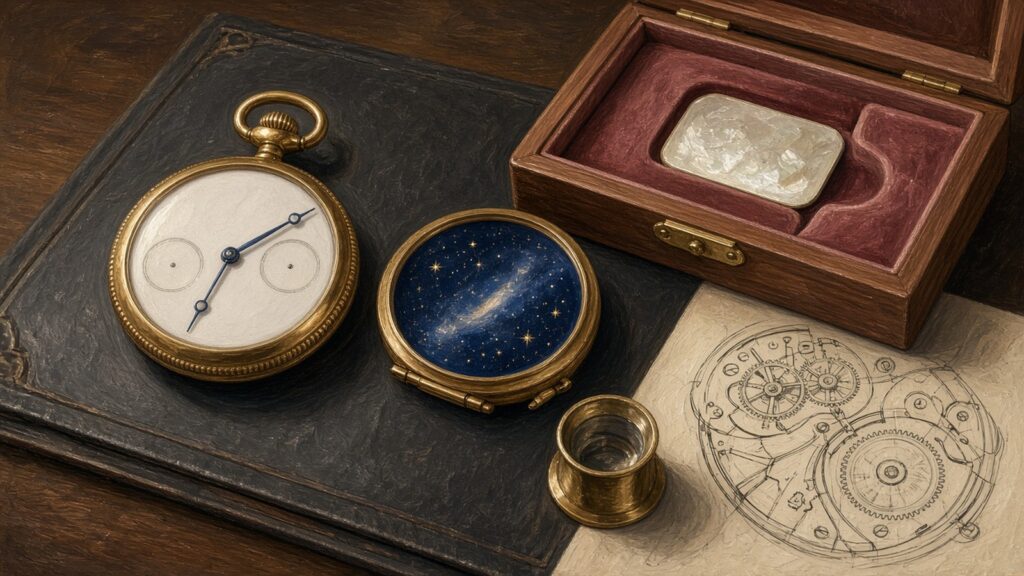
The Henry Graves Jr. Supercomplication is a Patek Philippe pocket watch that the banker Henry Graves Jr. ordered in 1925 as “the most complicated watch ever made.” Patek Philippe delivered it on January 19, 1933, for 60,000 Swiss francs, and it sold at Sotheby’s Geneva on November 11, 2014, for 23,237,000 Swiss francs, about $24 million (Sotheby’s, Guinness World Records). Here is how it was built, who owned it and what it teaches collectors.
The Collector’s Summary
The Supercomplication has 24 complications, according to Sotheby’s and Guinness World Records, and it stayed the world’s most complicated watch until Patek Philippe’s Calibre 89 in 1989. Graves paid 60,000 Swiss francs (about $15,000) in 1933. In 2014 it fetched 23,237,000 Swiss francs, which Guinness lists as the most expensive pocket watch sold at auction. Sotheby’s calls it the most complicated watch made without computer-aided design.
Jump to the timeline or what it teaches collectors.
What is the Henry Graves Supercomplication?
A yellow gold, double-dialed pocket watch with a minute repeater, Westminster chimes, grande and petite sonnerie, a split-seconds chronograph, a perpetual calendar accurate to 2100, moon phases, the equation of time, sidereal time, sunrise and sunset times, an alarm and a sky chart of New York (Sotheby’s). The sky chart shows the night sky above Graves’s Fifth Avenue apartment, with about 450 stars and the Milky Way. Sotheby’s says the movement was developed specifically for this one watch, and that it has 920 components including 430 screws and 70 jewels.
How many complications does it have?
Twenty-four, says Sotheby’s, which lists them in its catalogue and calls the Calibre 89 of 1989 its successor (Sotheby’s). A note by the former Patek Philippe Museum curator Alan Banbery in the same lot says 25. Guinness also gives 24 (Guinness World Records), so we use 24 and flag the difference. The Calibre 89 has 33.
Who was Henry Graves Jr.?
A New York banker and collector, born in 1868 and dead in 1953. Sotheby’s says he began buying Patek Philippe watches in the 1910s after Tiffany & Co. introduced him to the firm, and that he either commissioned watches or had Patek personalize ones he bought with his family’s coat of arms and the motto Esse Quam Videri, “To Be, Rather than to Seem” (Sotheby’s). He also collected prints, and a 1936 sale of his etchings and engravings was led by Dürer’s Adam and Eve.
What was the Graves–Packard contest?
A rivalry between two Patek Philippe clients, in Banbery’s telling. He writes that Graves and the automobile maker James Ward Packard of Warren, Ohio, vied to order the most complicated watch. By 1916, he says, Packard had edged ahead with a 16-complication pocket watch, and Graves then asked Patek, in secrecy, for “the most complicated watch ever made” (Sotheby’s catalogue note). Treat this as the auction house’s account rather than a settled one.
How long did the watch take to make, and what did it cost?
About seven years from order to delivery, with the watch “started in 1925, completed in 1932” and delivered on January 19, 1933 (Sotheby’s). Sotheby’s says Graves paid 60,000 Swiss francs, or $15,000. Guinness says the design needed three years of study in astronomy, mathematics and precision mechanics, and that Patek used outside specialists for parts of it (Guinness World Records).
Who owned the Supercomplication after Graves?
Graves’s family kept it until 1969. Sotheby’s lists the chain: Graves from 1933; his daughter Gwendolen Graves Fullerton by descent in 1953; her son Reginald H. “Pete” Fullerton by gift in 1960; the Time Museum in Rockford, Illinois, in 1969; Sotheby’s New York on December 2, 1999; and then a private collection (Sotheby’s). The Patek Philippe Museum in Geneva showed it from 2001 to 2005.
The timeline
| Date | What happened | Source |
|---|---|---|
| 1925 | Patek Philippe starts the watch for Henry Graves Jr. | Sotheby’s |
| 1932 | Patek Philippe completes it | Sotheby’s |
| January 19, 1933 | Delivered to Graves for 60,000 Swiss francs ($15,000) | Sotheby’s |
| 1953 | Graves dies; his daughter inherits it | Sotheby’s |
| 1960 | Gift to his grandson, Reginald H. Fullerton Jr. | Sotheby’s |
| 1969 | Sold to Seth G. Atwood’s Time Museum | Sotheby’s |
| 1989 | Patek Philippe’s Calibre 89 (33 complications) takes the title | Sotheby’s |
| December 2, 1999 | Sold at Sotheby’s New York, Time Museum sale | Sotheby’s |
| 2001–2005 | Shown at the Patek Philippe Museum, Geneva | Sotheby’s |
| November 11, 2014 | Sold at Sotheby’s Geneva for CHF 23,237,000 (about $24 million) | Sotheby’s, Guinness |
What it teaches collectors
The documents are part of the watch. The Supercomplication came with its original tulipwood box, the Patek Philippe Certificate of Origin and an Extract from the Archives, and its history can be followed in the factory’s own records and in the Stern Frères dial drawings Sotheby’s describes. Our authenticity checklist asks for the same things: papers, archive extracts and a clear chain of owners.
For another Patek with a famous owner, read Eric Clapton’s Patek 2499. For earlier grand complications, see Marie Antoinette’s Breguet, which Sotheby’s names among the watches Graves set out to beat, and Churchill’s Breguet. Browse the watches worth knowing for more.
Questions people ask
What is the Henry Graves Supercomplication?
It is a yellow gold Patek Philippe pocket watch that Henry Graves Jr. ordered in 1925 and received on January 19, 1933. Sotheby’s counts 24 complications, including a perpetual calendar, Westminster chimes and a sky chart of New York.
How much did the Graves Supercomplication sell for?
It sold for 23,237,000 Swiss francs, about $24 million, at Sotheby’s Geneva on November 11, 2014. Guinness World Records lists it as the most expensive pocket watch sold at auction. Graves had paid 60,000 Swiss francs, about $15,000, in 1933.
How many complications does the Supercomplication have?
Sotheby’s and Guinness World Records say 24. A note by the former Patek Philippe Museum curator in Sotheby’s lot says 25. It kept the title of most complicated watch until the 33-complication Calibre 89 of 1989.
Who bought the Henry Graves Supercomplication in 2014?
Neither the Sotheby’s catalogue nor the Guinness entry names the buyer. Sotheby’s lists the owner before the sale only as a private collection. Ignore any claim about the buyer that you cannot trace to a named source.
For another Patek Philippe with a famous owner, read John Lennon’s Patek Philippe 2499
Sources
- Sotheby’s, Important Watches, Geneva, November 11, 2014, lot 345: The Henry Graves Jr. Supercomplication
- Guinness World Records, Most expensive pocket watch sold at auction
Finely Owned is independent and isn’t affiliated with Patek Philippe, Sotheby’s or the Graves family.