

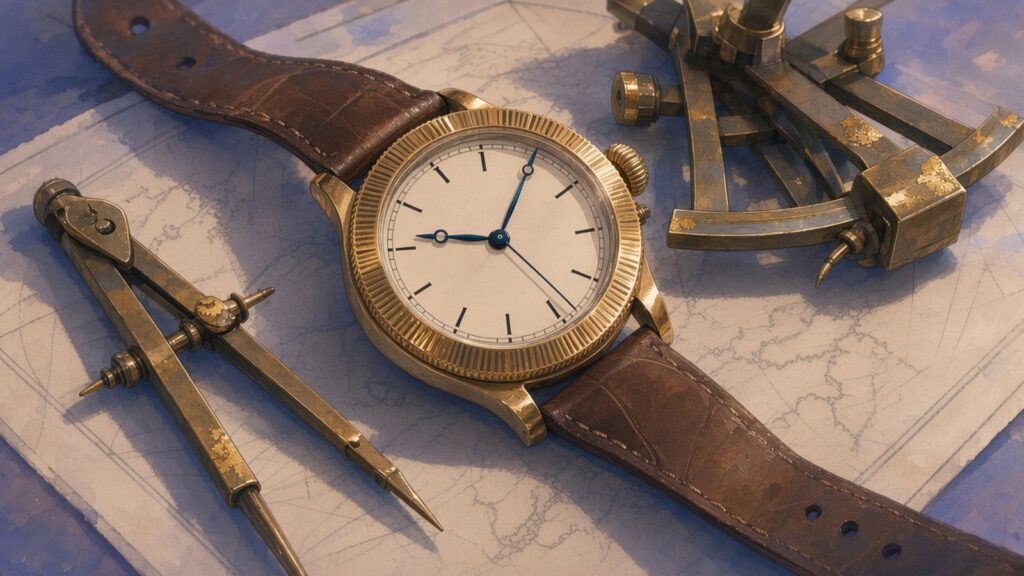
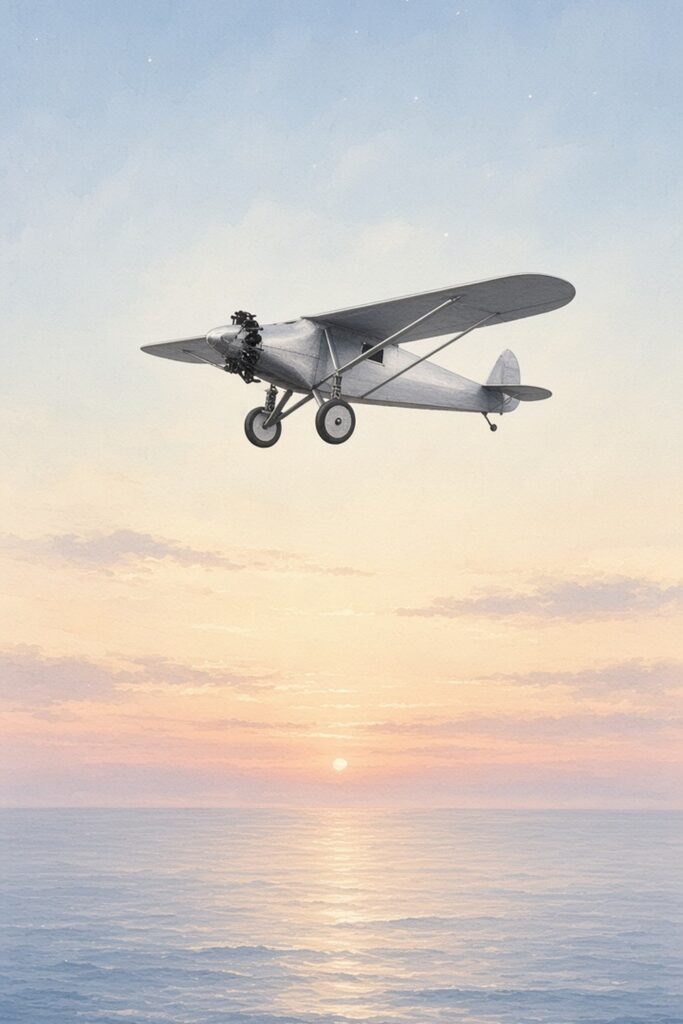
On 20 May 1927, Charles Lindbergh took off from Roosevelt Field in New York and landed at Le Bourget outside Paris after 33½ hours alone, the first nonstop solo flight across the Atlantic (WIPO). Longines timed the flight, and afterwards Lindbergh conceived a wristwatch to help pilots find their position by the stars, which Longines produced (Longines). His own example is in the Smithsonian’s National Air and Space Museum (National Air and Space Museum). Here is what the record shows about the Lindbergh Hour Angle watch, and what it teaches collectors.
The Collector’s Summary
The Hour Angle watch turns time into angle, so a navigator can read the Greenwich hour angle of the sun, a step toward longitude, straight off the dial (Hodinkee). Lindbergh worked out the design with his navigation teacher, Philip Van Horn Weems, and Longines registered it internationally in 1931 (WIPO). One from the first year of production, given by Lindbergh to the French aviator Dieudonné Costes, sold for CHF 143,000 at Phillips in Geneva in 2015 (SJX, The Jewellery Editor).
Jump to the timeline or what it teaches collectors.
How did Lindbergh navigate in 1927?
Without the stars. Hodinkee explains that he flew by dead reckoning, using his airspeed, compass and clock, and by pilotage, looking out of the window; carrying a navigator or taking sights himself would have added weight and work (Hodinkee). After Paris, he decided he had to learn celestial navigation. In April 1928, aboard the USS Langley, the US Navy’s first aircraft carrier, he met Lieutenant Commander Philip Van Horn Weems, who taught him (Hodinkee).
What does an hour angle watch do?
It converts time into degrees. The Earth turns 360 degrees in 24 hours, so each hour equals 15 degrees, and the watch’s dial and rotating bezel are marked in both (Hodinkee). The bezel turns to allow for the equation of time, and the center dial turns so the seconds can be set to a radio time signal, an idea Weems patented in 1929 as the Second-Setting Watch (Hodinkee, Navlist). The precision mattered: a 30-second error could throw a position off by as much as seven miles (Navlist). The watch does not give longitude by itself; it gives the sun’s Greenwich hour angle, which the navigator then works from (Navlist).
Who made it?
Longines, through its American partner, Longines-Wittnauer. A navigation history published on Navlist says that in 1931 Lindbergh suggested a rotating bezel and angle marks, and Longines-Wittnauer combined them with Weems’s second-setting system (Navlist). Hodinkee notes that the Longines executive John P. V. Heinmuller, a pilot who had officially timed Lindbergh’s landing in 1927, was the man Lindbergh brought the design to (Hodinkee). WIPO says Longines registered the design in 1931 as an international deposit under the Hague Agreement, with a 47.5 mm case and a large crown for gloved hands (WIPO).
Where is Lindbergh’s own watch?
At the National Air and Space Museum in Washington. The museum lists a Longines Lindbergh Hour Angle watch owned by Charles A. Lindbergh, designed by Weems and Lindbergh and made by the Longines-Wittnauer Watch Co., and describes it as a “watch developed and used by Lindbergh in celestial navigation” (National Air and Space Museum). It was transferred from the United States Air Force Museum and is shown in the Barron Hilton Pioneers of Flight gallery (National Air and Space Museum). We found no record of a serial number for it.
What did the Costes watch sell for?
CHF 143,000. At Phillips’ first Geneva watch auction in 2015, lot 86 was a 47 mm Hour Angle from the first year of production that Lindbergh had given to Dieudonné Costes, the French aviator; it was estimated at CHF 60,000 to 80,000 (SJX). It sold for CHF 143,000 (The Jewellery Editor). Longines has reissued the design several times, first for the 60th anniversary of the flight in 1987, and its current version returns to the original 47.5 mm size with an automatic movement (Hodinkee, Longines).
The timeline
| Date | What happened | Source |
|---|---|---|
| 20–21 May 1927 | Lindbergh flies New York to Paris nonstop and alone; Longines times the flight | WIPO |
| April 1928 | Lindbergh meets Philip Van Horn Weems aboard the USS Langley | Hodinkee |
| 1929 | Weems patents the Second-Setting Watch | Navlist |
| 1931 | Longines registers the Hour Angle design under the Hague Agreement | WIPO |
| 1931 | Lindbergh’s bezel and angle marks are combined with Weems’s system | Navlist |
| 1987 | Longines reissues the watch for the flight’s 60th anniversary | Hodinkee |
| 2015 | The Costes watch, lot 86, sells for CHF 143,000 at Phillips Geneva | The Jewellery Editor |
What it teaches collectors
Know which watch the story belongs to. Lindbergh’s own Hour Angle is in a museum, and the one that made six figures at auction did so because it came from Lindbergh’s hands to another famous pilot. An ordinary period Hour Angle, or a modern Longines reissue, carries the design but not that provenance. If a seller links a watch to a named person, ask for the letter, the photograph or the auction record that proves it, and use our authenticity checklist.
For another Longines with a famous owner, read Albert Einstein’s Longines. For whether the brand is worth buying today, see Is Longines Worth It?. For another record-breaker’s watch, see Sir Malcolm Campbell’s Rolex, and for the flight to the moon, Buzz Aldrin’s Omega Speedmaster. For the vertical hub, see the watches worth knowing.
Questions people ask
Did Charles Lindbergh design the Longines Hour Angle watch?
Yes, with his navigation teacher Philip Van Horn Weems. Longines says Lindbergh conceived the design after his 1927 flight and entrusted its production to Longines.
How does the Lindbergh Hour Angle watch work?
Its dial and rotating bezel convert time into degrees, 15 degrees for each hour, so a navigator can read the Greenwich hour angle of the sun, a step toward finding longitude.
Where is Lindbergh’s Hour Angle watch?
His own example is at the Smithsonian’s National Air and Space Museum in Washington, in the Barron Hilton Pioneers of Flight gallery.
How much is an original Lindbergh Hour Angle worth?
The one Lindbergh gave to Dieudonné Costes sold for CHF 143,000 at Phillips in Geneva in 2015. Watches without that provenance are a different market.
For another pilot’s navigation watch, read Is the Breitling Navitimer Worth It?
Sources
- WIPO, Longines Pilot Watches: Design in Flight and Beyond
- Longines Media Center, The Lindbergh Hour Angle Watch
- Hodinkee, The Science, History, and Romance Behind the Longines Lindbergh Hour Angle Watch (2015)
- Navlist, Lindbergh-Weems Second-Setting Pilot’s Watch
- National Air and Space Museum, Watch, Celestial Navigation, Longines, Lindbergh Hour Angle
- SJX, Highlights from Phillips’ inaugural Geneva watch auction (2015)
- The Jewellery Editor, Longines Hour Angle watch, 1931
Finely Owned is independent and isn’t affiliated with Longines, Phillips, the Smithsonian or the Lindbergh family.